
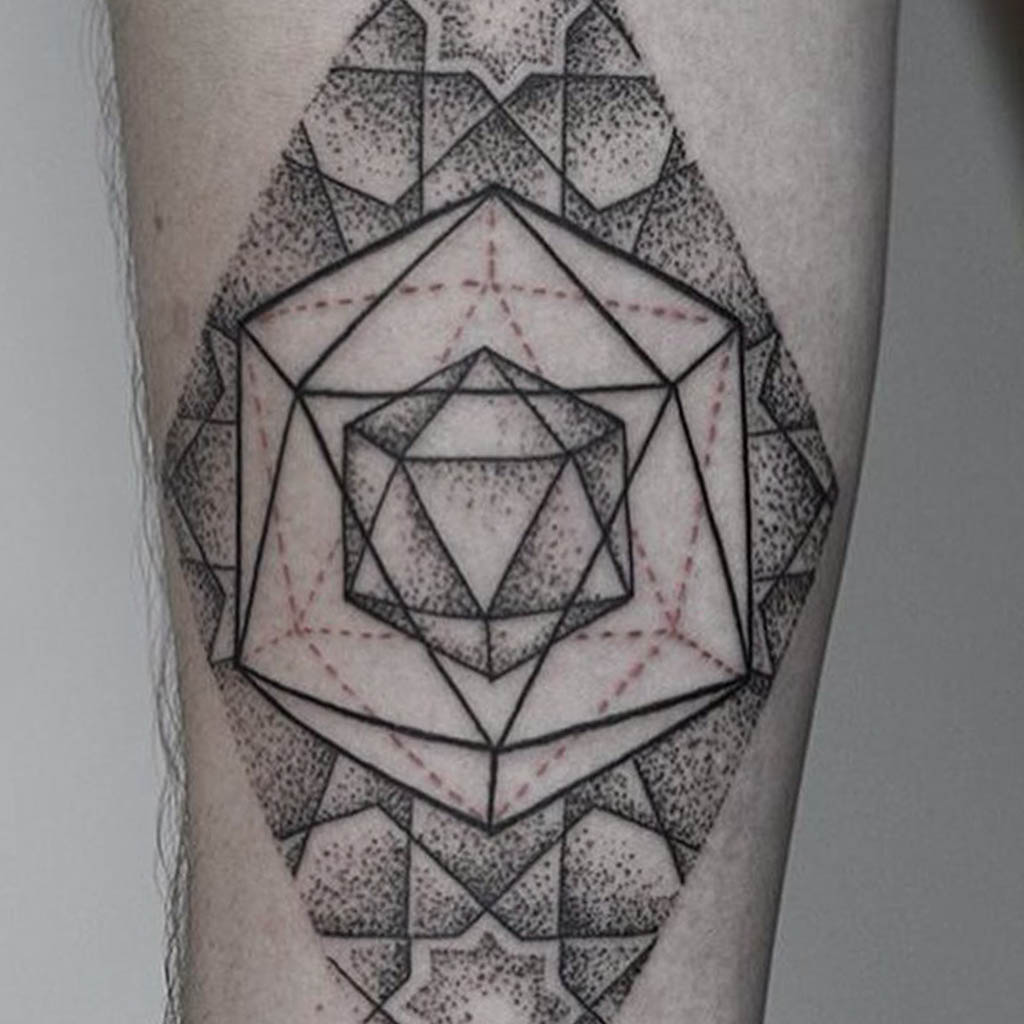
There’s something immediately soothing about a well-designed geometric tattoo.
The repetition, symmetry and precision, the longer you look at some designs, the more you start noticing. A simple circle becomes part of another circle. Lines intersect to create shapes within shapes. A pattern that looks fairly simple from a distance can contain an enormous amount of detail when you get closer.
Sacred geometry takes that idea further by using geometric forms that have acquired religious, philosophical or spiritual significance. Some have histories stretching back centuries. Others are much more modern than you might assume.
Understanding the background behind this style of image is important before you deciding what you want permanently tattooed on your body.
You might be interested in the symbolism. You might have a connection with a particular spiritual tradition. Or you may simply love the order, balance and appearance of geometric artwork.
All of those can be good reasons to explore it.
From a tattooing point of view, though, there’s another side to sacred geometry that I find particularly interesting. These designs demand precision, and that geometry has to work on a surface that is neither flat nor still.
Your body bends, twists, stretches and changes shape as you move.
That makes designing a good geometric tattoo very different from drawing a perfect geometric pattern on a piece of paper.
Take a look at my geometric tattoo gallery here.
Explore Sacred Geometry Tattoos
Flower of Life · Seed of Life · Metatron’s Cube · Sri Yantra · Mandalas · Platonic Solids · Tattoo Styles · Placement · Choosing an Artist
What Is Sacred Geometry?
Sacred geometry is a broad modern term used for geometric shapes, proportions and patterns that are given religious, philosophical or spiritual significance.
The basic ingredients themselves couldn’t be simpler: circles, squares, triangles, spirals, polygons and intersecting lines.
Repeat them, rotate them or place them within one another and remarkably complicated patterns can emerge from a few very simple rules.
Humans have been doing this for a very long time.
Geometry appears in religious buildings, manuscripts, mosaics, decorative art and ritual objects from cultures across the world. You can see elaborate geometric patterning in Islamic art, geometrically organised mandalas in Buddhist traditions, yantras within Hindu Tantric traditions and geometrical structures throughout European religious art and architecture.
That doesn’t mean they are all examples of a single ancient system called “sacred geometry”.
That’s an important distinction.
The phrase is now commonly used to bring a lot of different ideas together, particularly in modern art, tattooing and spirituality. Historically, however, these traditions developed in different places, at different times and with very different meanings.
For somebody researching a tattoo, I don’t think that makes them any less interesting. If anything, knowing where a design actually comes from gives you much more to work with.
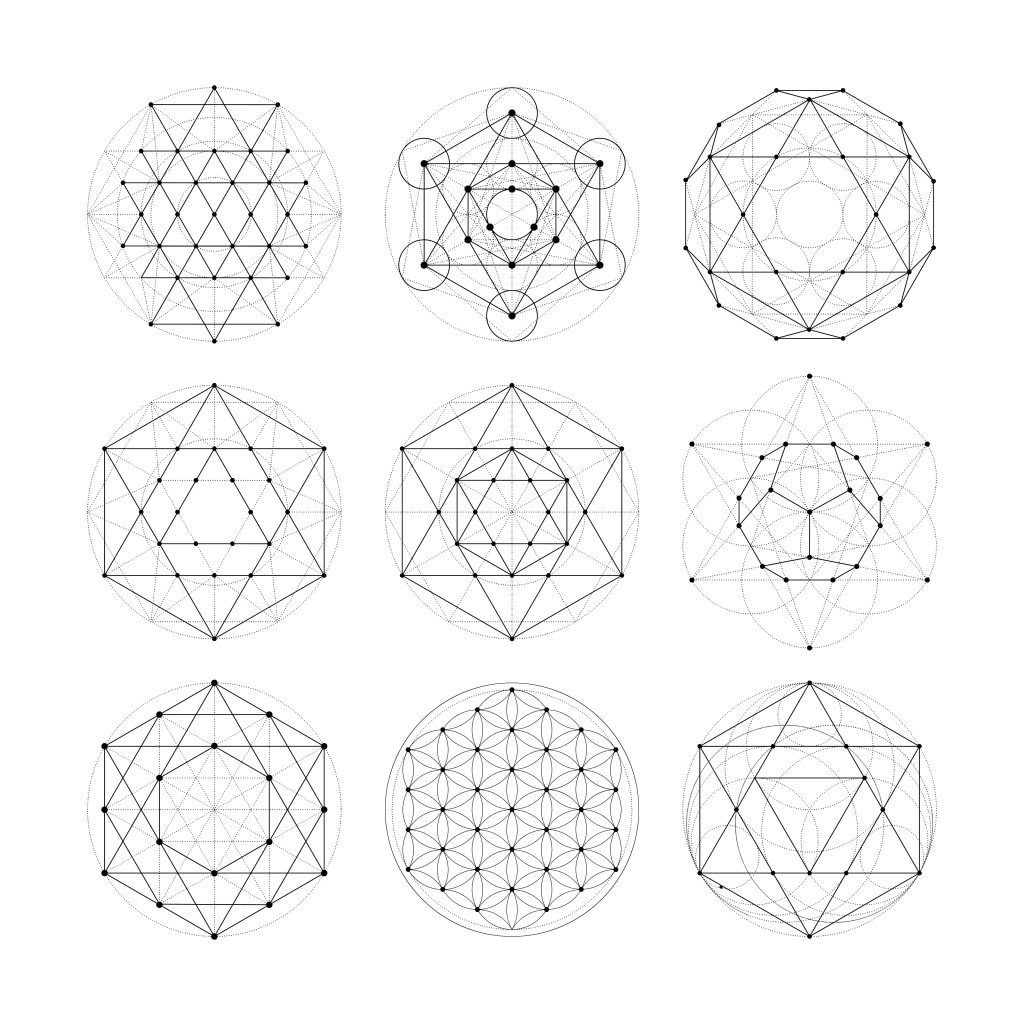
Why Does Sacred Geometry Work So Well as a Tattoo?
Geometry gives you an enormous amount of freedom.
A design can be reduced to a few circles and lines or expanded across an entire back. It can sit neatly in the centre of the chest, radiate out from the shoulder, wrap around an arm or become the underlying structure of a full sleeve.
It also combines well with other styles.
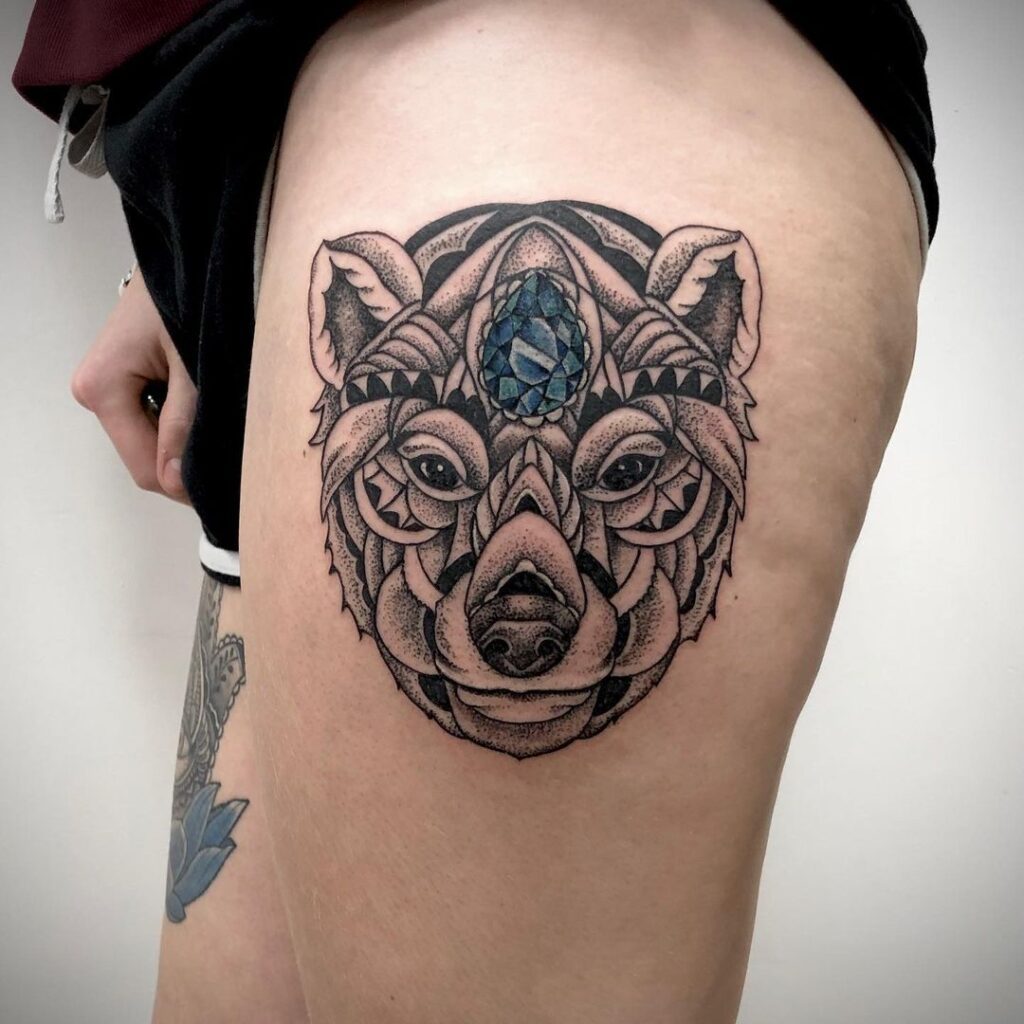
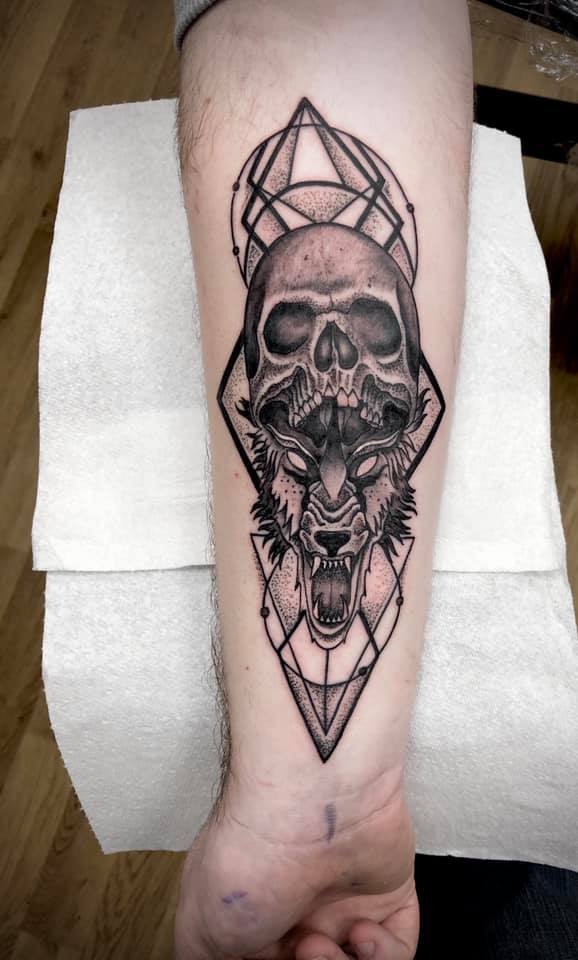
I’ve seen geometric structures used alongside flowers, animals, skulls, planets, landscapes and more traditional illustrative tattooing. The contrast can work particularly well because you have something organic sitting against something very controlled.
There is also no obvious finishing point with many repeating geometric patterns. Once you establish the underlying structure, it can potentially continue.
That can be useful if you’re planning a larger tattoo or think you may eventually want to extend the piece.
The challenge is that geometry exposes mistakes very easily.
If you draw a slightly irregular line in fur, hair, smoke or foliage, your eye may never notice it. Put the same irregularity into a row of perfectly spaced parallel lines and suddenly it’s the first thing you see.
That’s why the design and the tattooing itself both matter.
Popular Sacred Geometry Tattoo Designs and Their Meanings
One of the first things people tend to do when researching sacred geometry tattoos is search for the meanings of individual symbols.
That’s useful, but it’s also where things can get a little muddled.
A symbol may have a genuine historical religious meaning, a much later esoteric interpretation and dozens of modern meanings attached to it online.
They aren’t necessarily the same thing.
Here are some of the designs you’re likely to encounter.
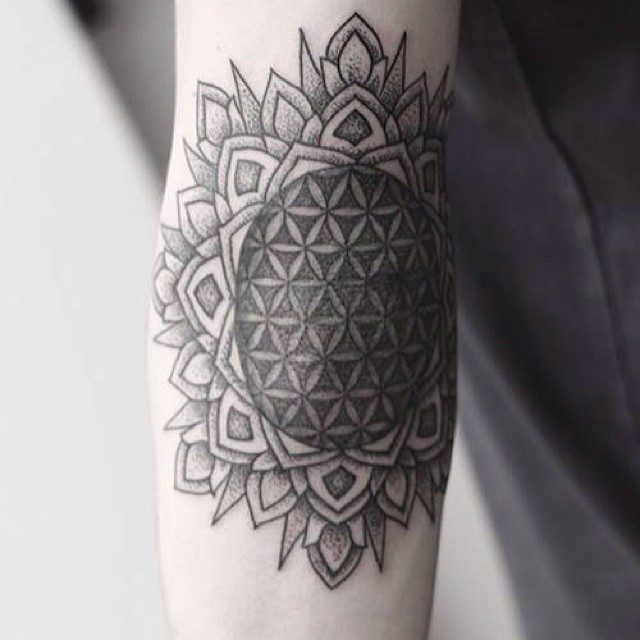
The Flower of Life
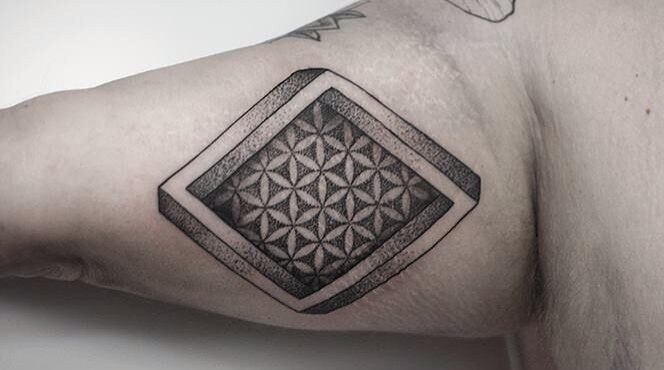
The Flower of Life is probably one of the most recognisable designs associated with modern sacred geometry.
It consists of evenly spaced overlapping circles arranged to create a repeating flower-like pattern.
As a tattoo, it has a lot going for it. The pattern is symmetrical, immediately recognisable and can be kept relatively simple or used as the basis for a much more elaborate piece.
You’ll often find the Flower of Life described online as an ancient universal symbol representing creation, consciousness, interconnectedness or the underlying structure of the universe.
I’d be careful with some of those claims.
Intersecting-circle patterns certainly have a long history, but the modern concept of the Flower of Life as a named sacred-geometric system is much newer than many websites suggest.
That doesn’t prevent you attaching your own meaning to it. It just helps to separate modern spiritual interpretation from established history.
From a tattoo perspective, the bigger consideration is how much of the pattern you want to include.
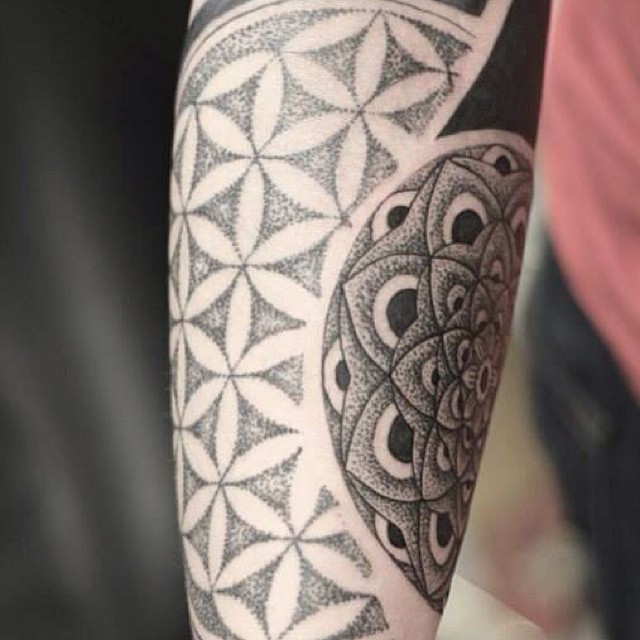
A relatively open Flower of Life can remain clean and readable. Once you start adding more circles, fine internal lines, dotwork and additional geometry, the amount of space required increases surprisingly quickly.
Trying to squeeze too much geometry into a small tattoo rarely improves it.
The Seed of Life
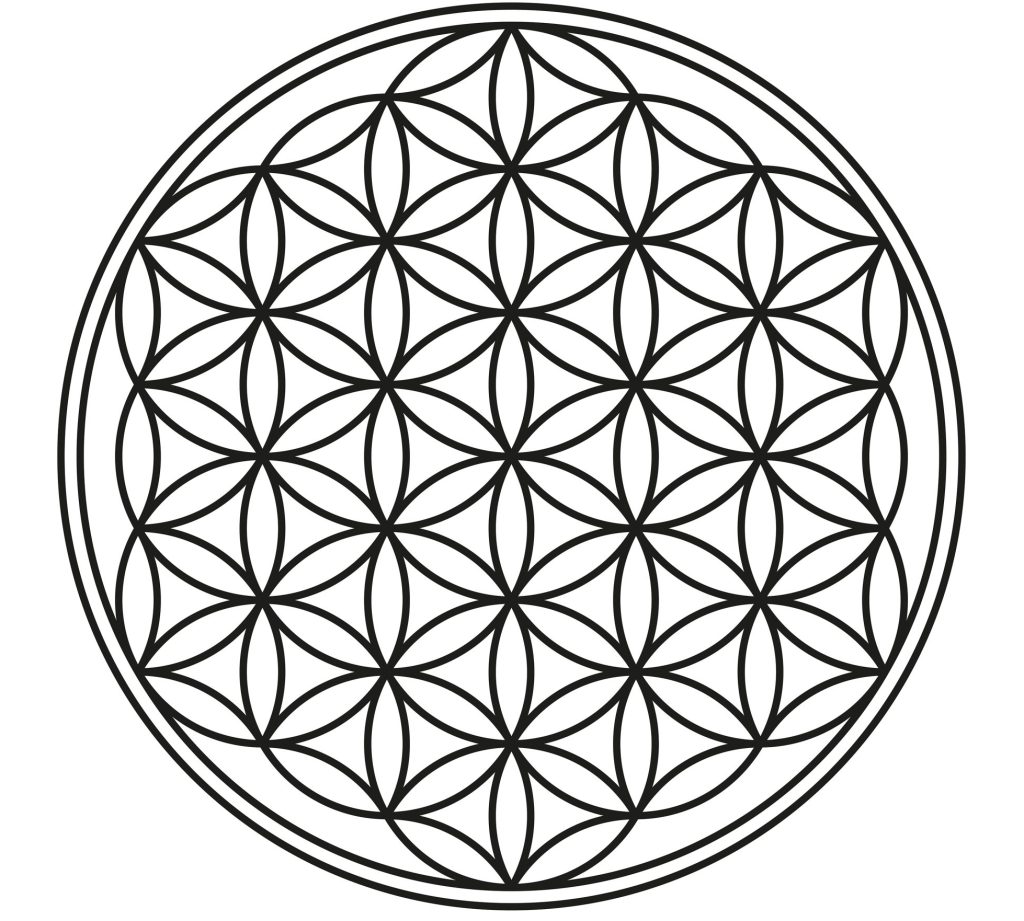
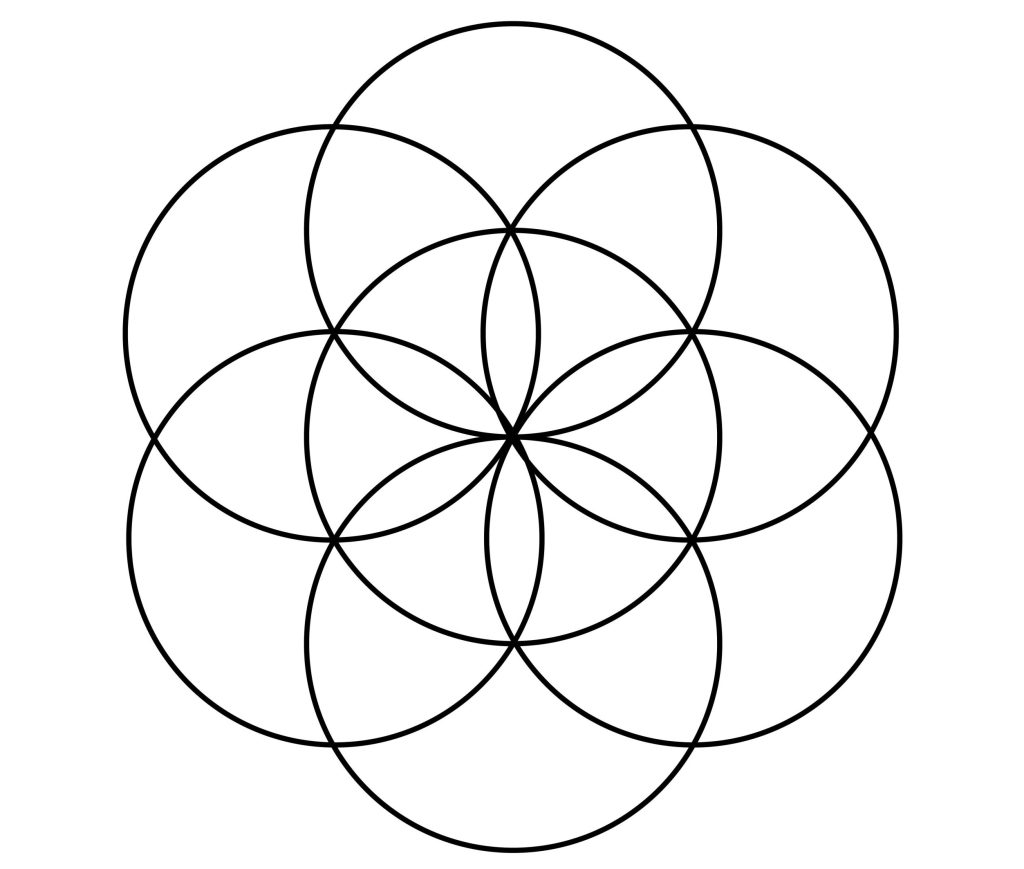
The Seed of Life is formed from seven overlapping circles and has become another familiar part of modern sacred geometry.
Visually, it’s simpler than the Flower of Life.
That simplicity can actually make it more useful for tattooing.
There’s enough repetition to create the geometric effect without requiring a particularly large area of skin, and the design can work either by itself or as the centre of something larger.
Modern interpretations often associate the Seed of Life with beginnings, creation and growth.
If that meaning matters to you, there’s nothing wrong with incorporating it into the reason for choosing the tattoo. I would simply regard those meanings as part of the symbol’s modern sacred-geometry interpretation rather than assuming there is one fixed ancient definition.
Metatron’s Cube
Metatron’s Cube is one of those designs where the internet can very quickly turn modern symbolism into supposed ancient history.
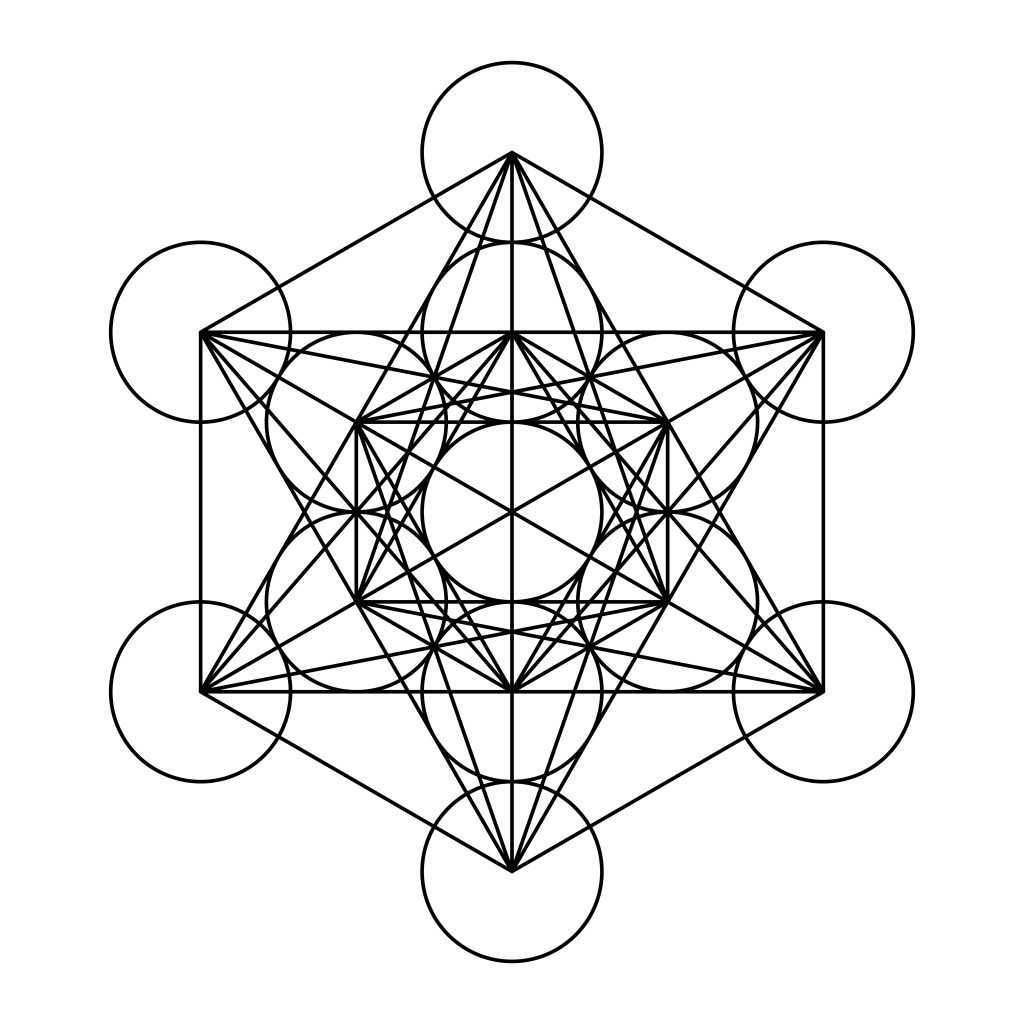
The familiar design is built from circles and connecting straight lines, producing a dense network of geometric forms. You can identify representations of the five Platonic solids within its structure, which is one reason it has become so popular in modern sacred geometry.
It’s often described as an ancient Kabbalistic symbol.
The history is considerably less straightforward than that.
Metatron is an established figure in Jewish mystical traditions, but evidence for the familiar geometric diagram being historically known as “Metatron’s Cube” is lacking. The association between Metatron and this particular diagram appears to belong to much more recent Western esoteric and sacred-geometry traditions.
As tattoo artwork, though, I can understand the appeal immediately.
There is a lot happening inside the design. The straight connecting lines contrast with the circles, and it lends itself very well to blackwork and dotwork.
It also needs room.
Reducing a complicated Metatron’s Cube until all those intersections are only millimetres apart may look impressive on a phone screen, but that doesn’t automatically make it a sensible tattoo.
The Sri Yantra
The Sri Yantra is visually extraordinary, but this is one design where it’s particularly worth understanding what you’re looking at before treating it as decorative geometry.
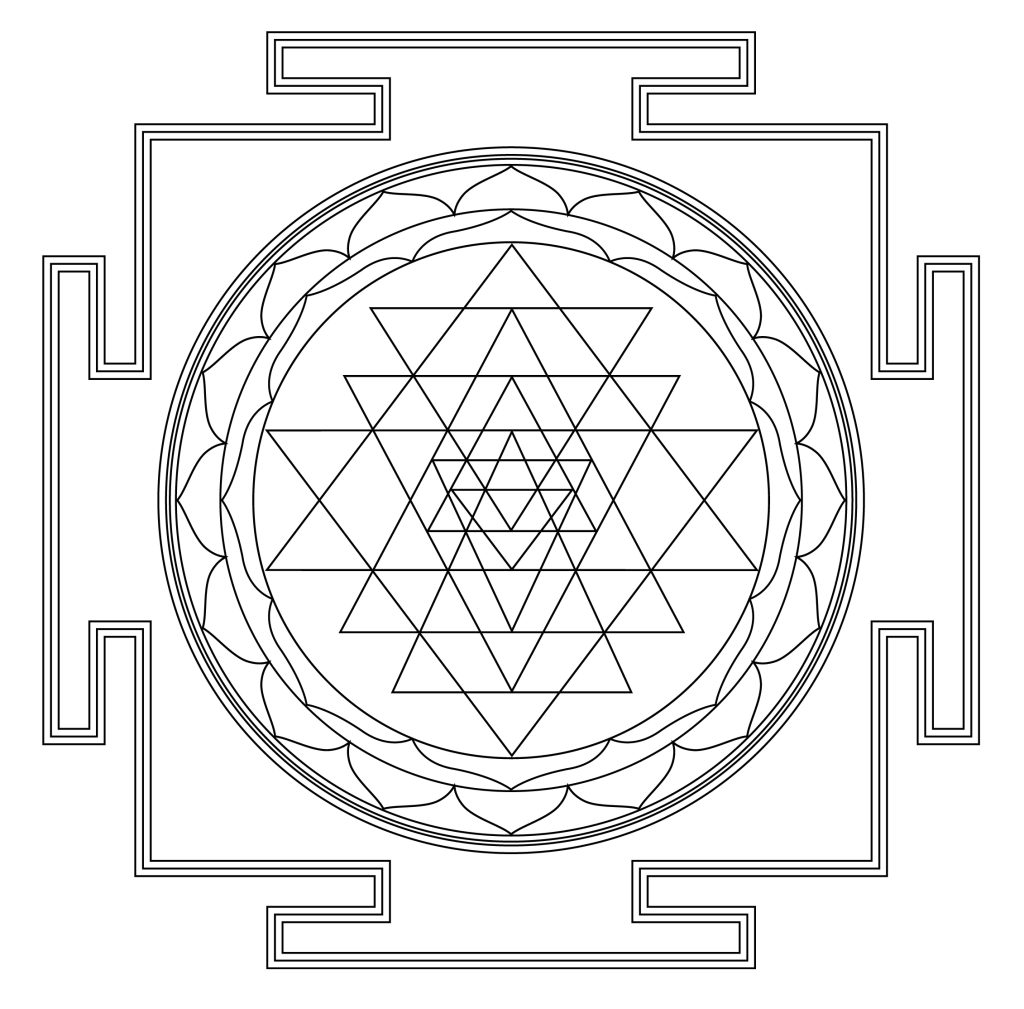
It comes from the Hindu Śrīvidyā tradition and is composed around nine interlocking triangles, traditionally five downward-pointing and four upward-pointing, arranged around a central point known as the bindu. Their intersections create 43 smaller triangles within the central structure.
Within its religious context, this isn’t simply an attractive pattern.
The Sri Yantra is used as a meditative and ritual diagram and is associated with the goddess Tripurasundarī and a much larger system of Tantric symbolism and practice.
That doesn’t mean somebody outside that tradition is forbidden from being interested in the artwork. It does mean I’d spend some time learning what the design is before deciding to have one tattooed.
Technically, it is also an unforgiving piece.
Nine interlocking triangles create a lot of intersections. Tiny errors in angle and position can affect the whole structure, so this is one of those tattoos where accurate preparation and enough physical space really matter.
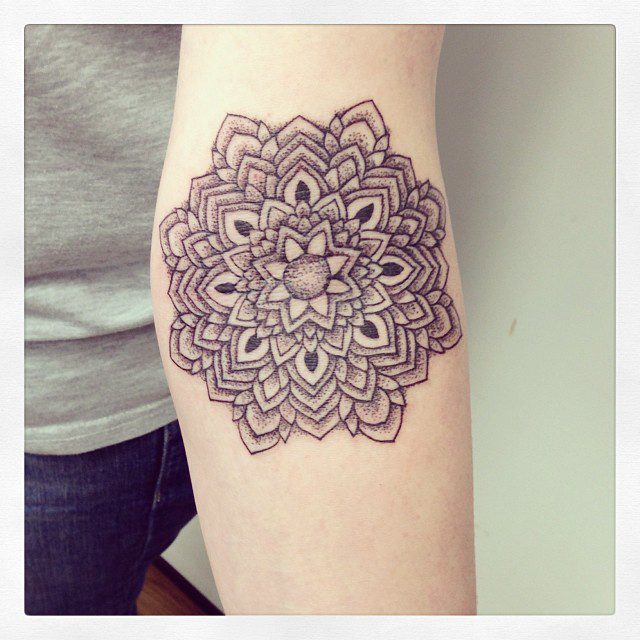
Mandala Tattoos
The word mandala gets used very loosely in tattooing.
Almost any circular symmetrical pattern can end up being described as a mandala, but historically the term has much more specific religious uses.
Mandalas are important within Buddhist traditions, where they can represent complex cosmological and religious ideas rather than simply functioning as decoration.
Some Tibetan Buddhist sand mandalas are painstakingly constructed and then deliberately dismantled, with the process itself connected to Buddhist teachings about impermanence.
Modern mandala-style tattooing has developed well beyond those traditional forms.
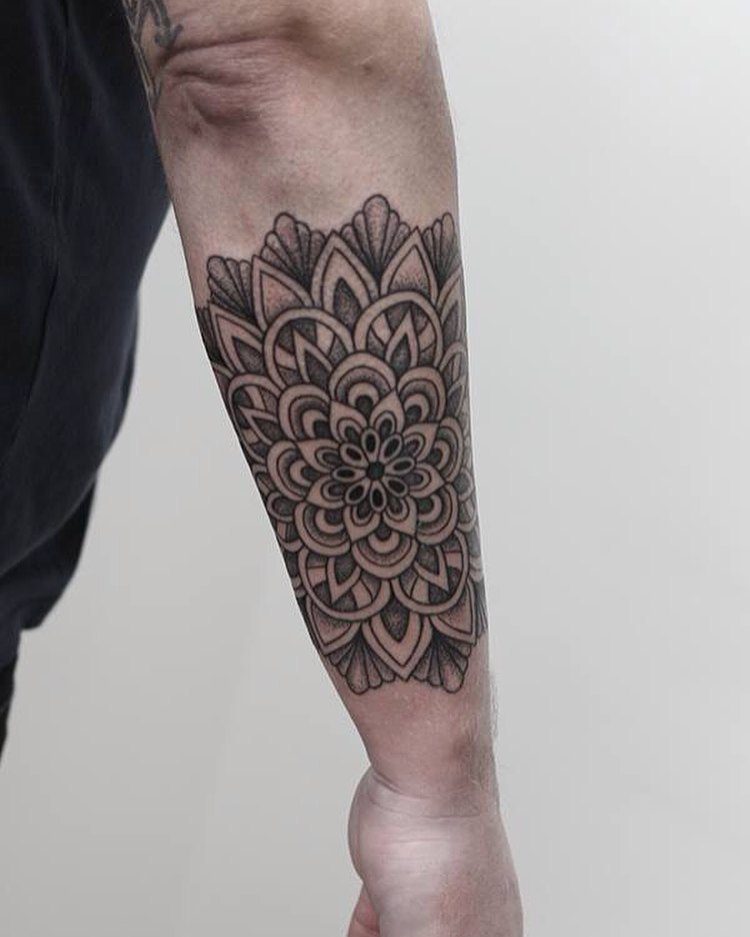
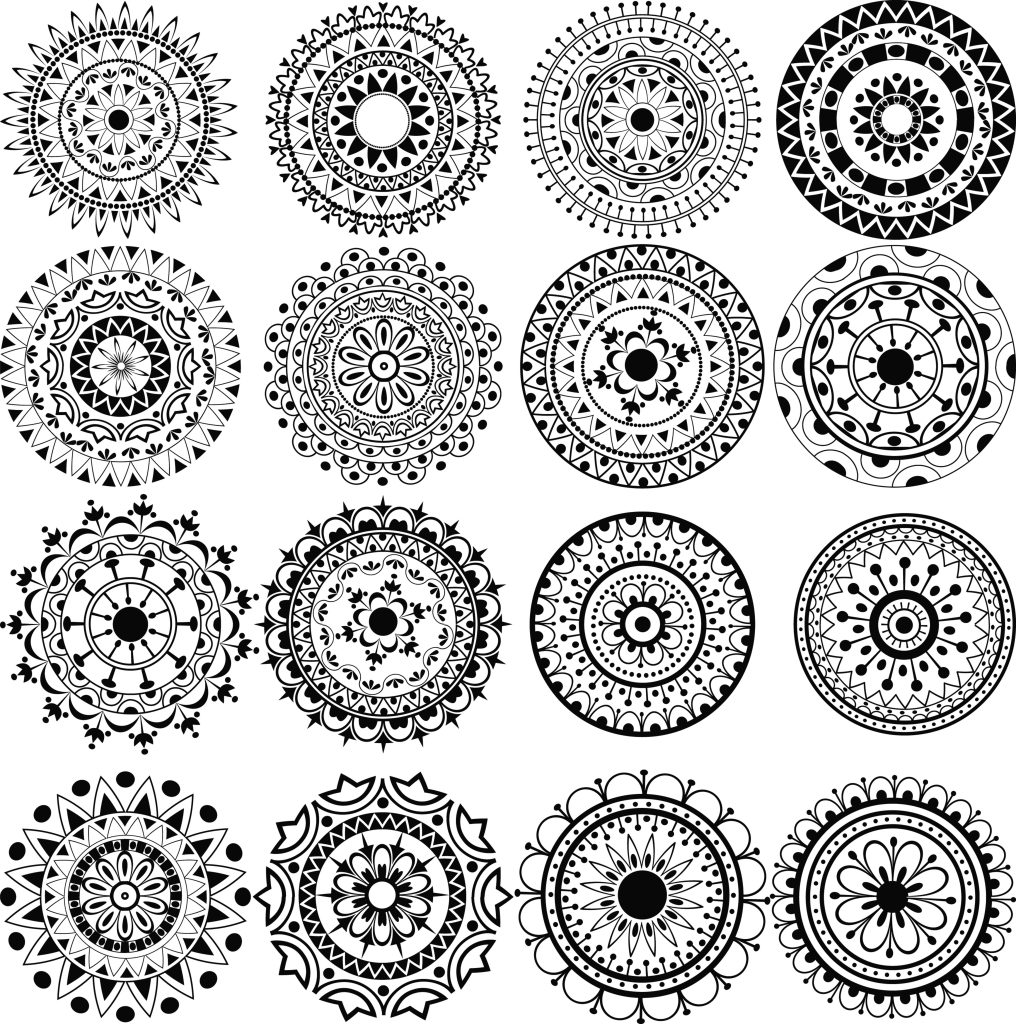
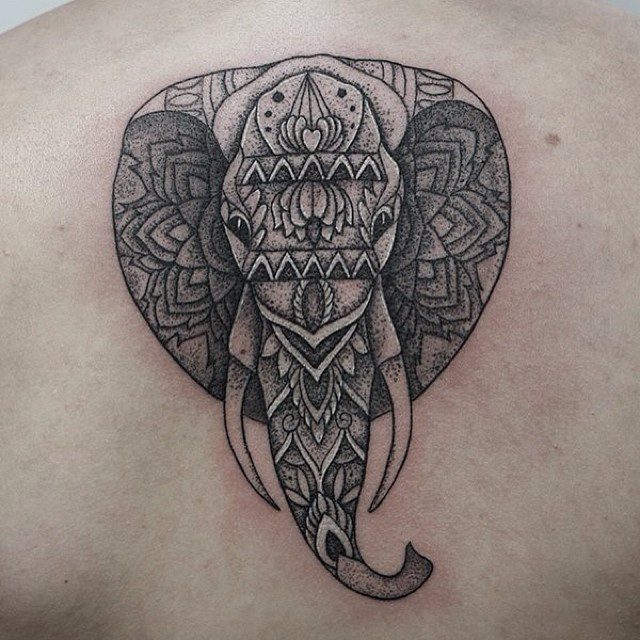
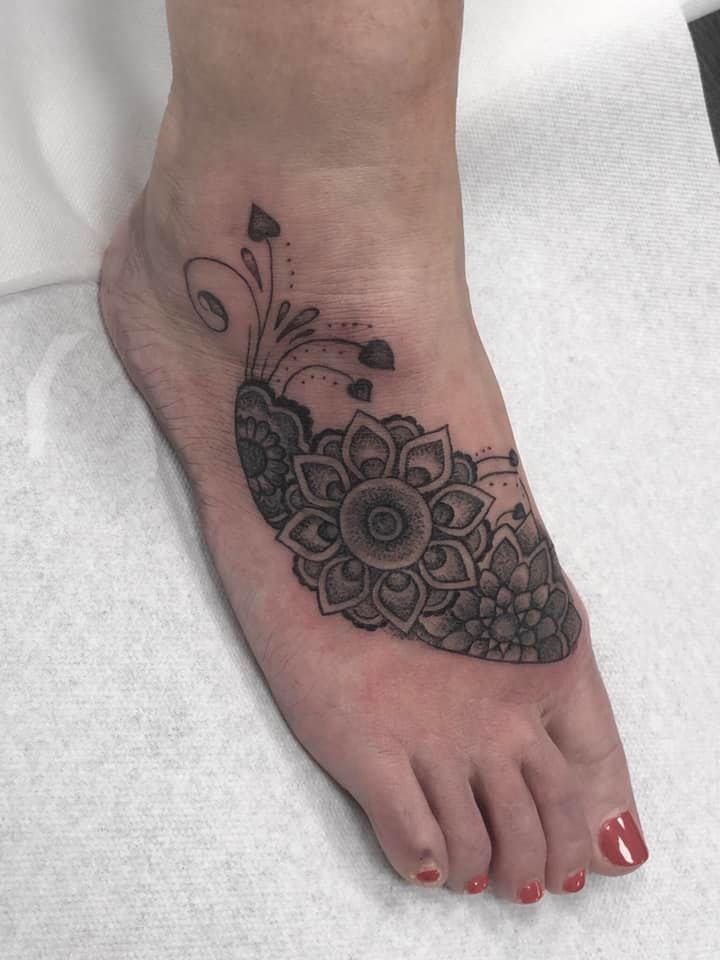
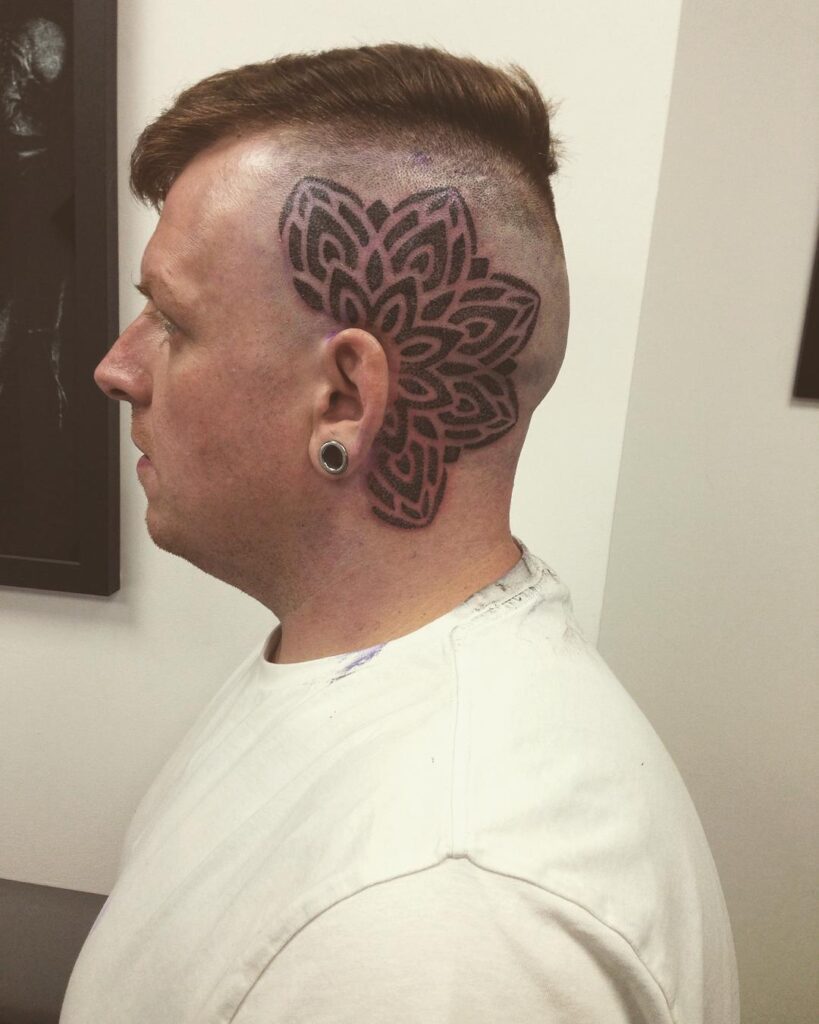
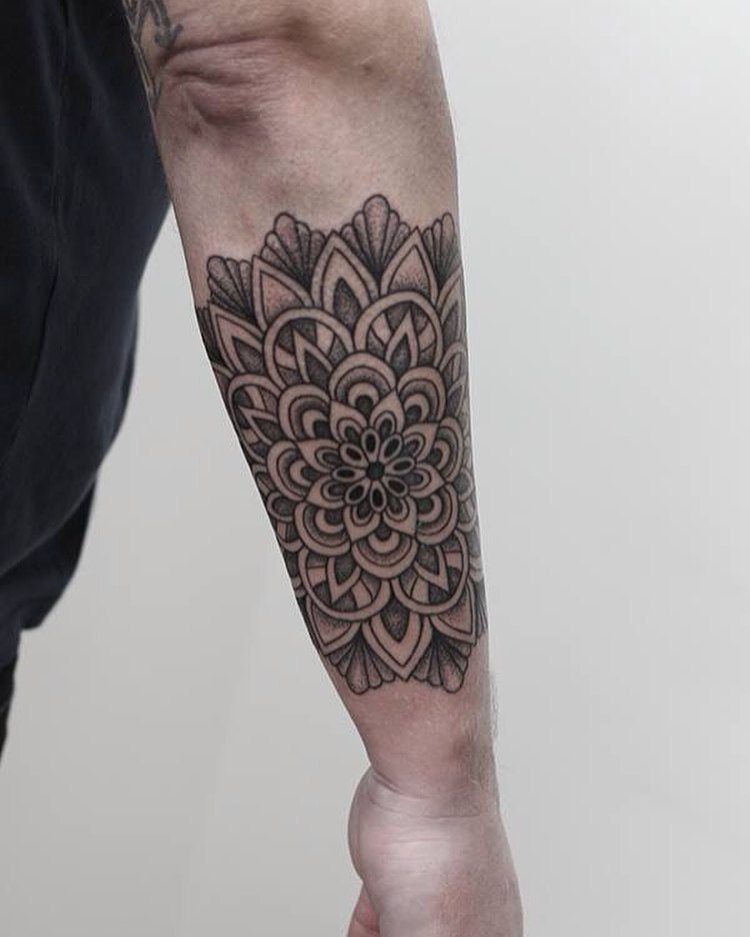
In tattoo terms, we often use the word for radial designs built outward from a central point. They may borrow from traditional imagery, use floral forms or be completely original geometric compositions.
The shape works particularly well with certain areas of the body.
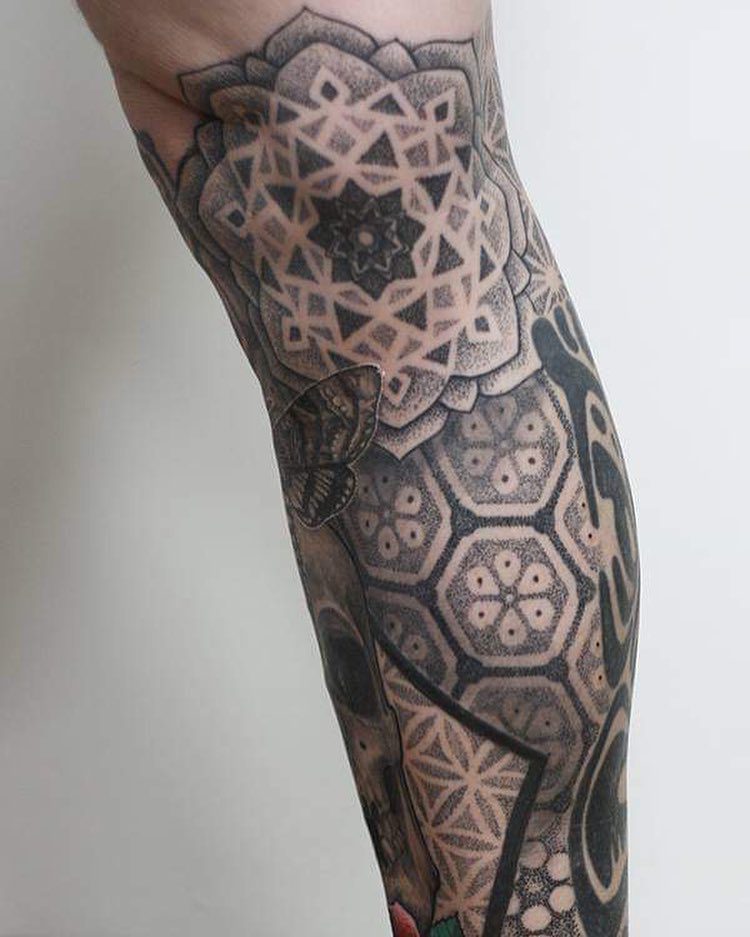
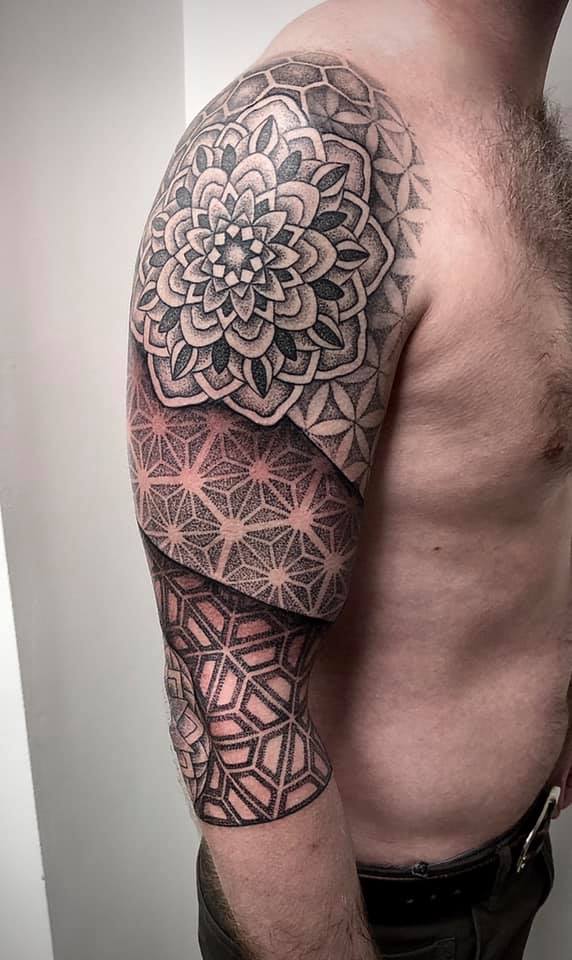
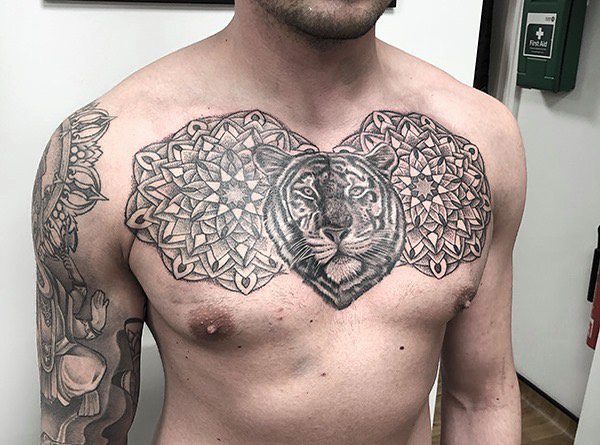
Shoulders are an obvious example because the tattoo can radiate out from the natural rounded form of the shoulder. The chest and upper back offer larger areas, while elbows and knees can be incorporated into radial designs in interesting ways.
The important thing is knowing whether you’re using a specific religious design or simply creating a geometric tattoo with a mandala-like structure.
Those aren’t quite the same thing.
The Vesica Piscis
The Vesica Piscis is beautifully simple.
Take two circles of equal radius and overlap them so that the centre of each circle lies on the circumference of the other. The almond-shaped area where they overlap is the vesica.
Variations of this geometry have appeared in different cultures and historical periods. Its precise origin isn’t known, although the form became particularly significant within Christian art and architecture.
As part of a tattoo, the Vesica Piscis can be used by itself, but it’s probably more interesting as a building block.
Once circles begin intersecting, you can construct increasingly complicated patterns from a very simple starting point.
That’s one of the things I like about geometric artwork generally. Complexity doesn’t always require complicated ingredients.
Platonic Solids
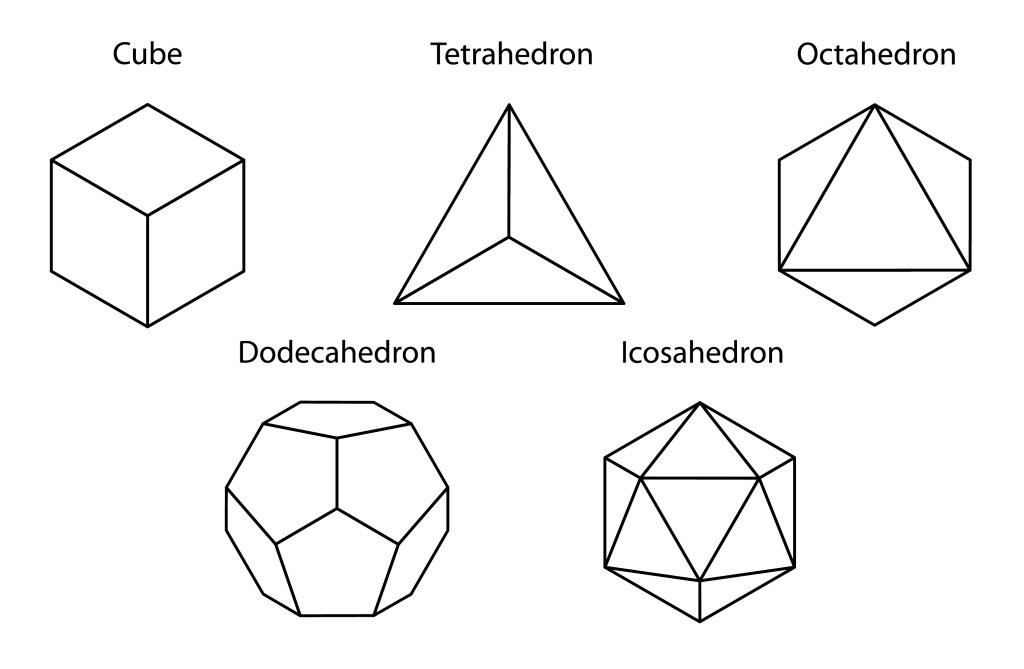
The five Platonic solids are the tetrahedron, cube, octahedron, dodecahedron and icosahedron.
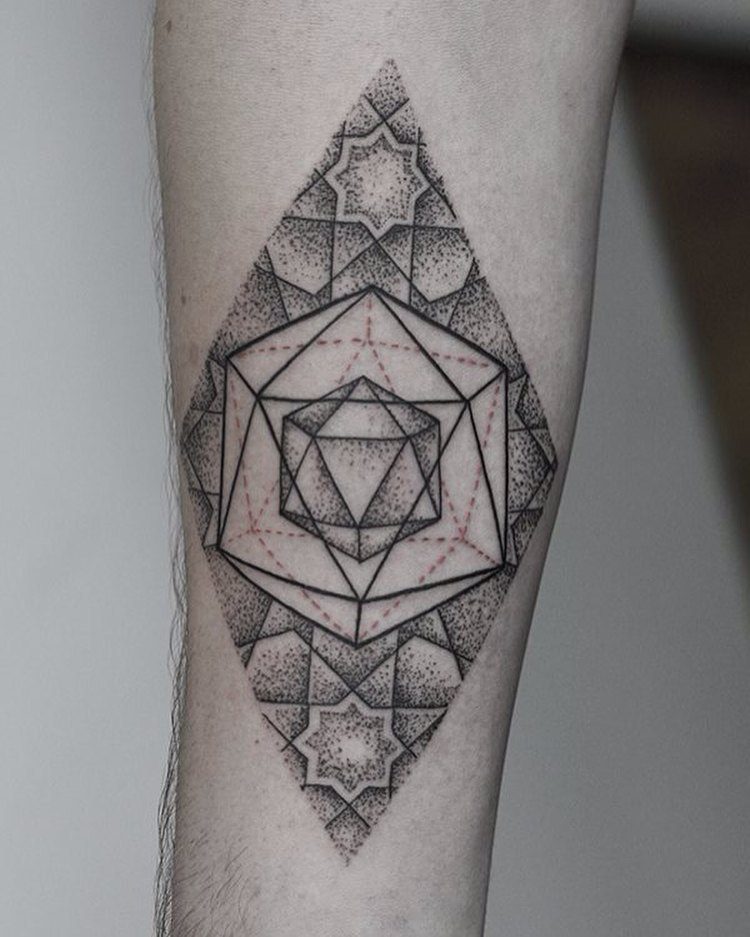
Mathematically, they are the five convex regular polyhedra: three-dimensional forms whose faces are identical regular polygons arranged in the same way at every vertex.
Their association with philosophy goes back at least to ancient Greece.
In Plato’s Timaeus, the tetrahedron is associated with fire, the octahedron with air, the icosahedron with water and the cube with earth. The fifth solid, the dodecahedron, is given a different cosmological role.
That genuine history is interesting enough without needing to embellish it.
As tattoos, Platonic solids can look very clean as simple linework, but they can also be incorporated into much more complicated geometric compositions.
There’s also something visually appealing about representing a three-dimensional object using nothing but lines on the skin.
Spirals, Fibonacci and the Golden Ratio
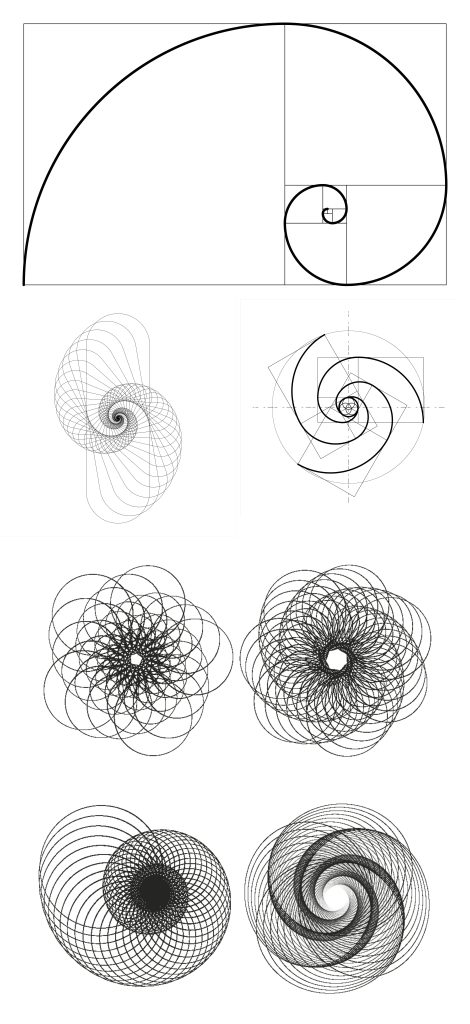
Spirals are another natural fit for geometric tattooing because they introduce movement into a style that can otherwise become very rigid.
This is also an area where I see a lot of claims repeated as fact.
The Fibonacci sequence and golden ratio are genuine mathematics. Fibonacci numbers progressively approximate the golden ratio as the sequence continues.
The leap comes when every shell, flower, face, hurricane and galaxy gets presented as proof that nature has been designed according to one perfect mathematical proportion.
Nature is messier than that.
The nautilus shell, for example, is constantly used to illustrate the golden spiral despite measurements showing that nautilus shells don’t consistently conform to it.
None of that makes a Fibonacci or golden-ratio-inspired tattoo less interesting.
The mathematics is real. The geometry looks good. You just don’t need to claim that the entire universe secretly follows it to justify getting one tattooed.
Sacred Geometry Tattoo Styles
Knowing which symbol interests you is only part of the decision.
The same basic geometry can produce completely different tattoos depending on how it’s drawn and tattooed.
Fine-Line Geometry
Fine-line work suits geometry for obvious reasons.
Thin lines allow a tattoo artist to create complicated structures without the finished tattoo becoming overwhelmingly dark. It can give sacred geometry a very clean, almost technical appearance.
There is a limit, though.
The smaller the tattoo and the closer those lines sit together, the less room there is for the design to change over time.
Tattooed lines don’t remain mathematically identical to the day they were applied. Skin heals and ages. Ink settles. Bodies change.
That doesn’t mean fine-line geometry is a bad idea. It means the scale needs to suit the amount of detail.
Sometimes making a design slightly larger makes an enormous difference to how well it can be tattooed.
Dotwork Sacred Geometry
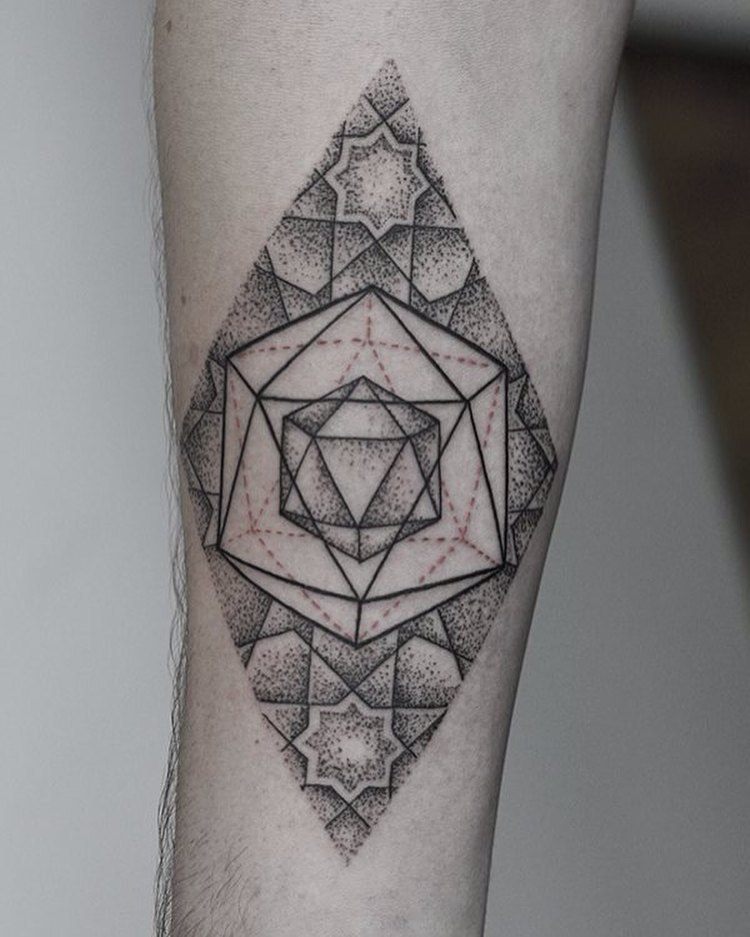
Dotwork and sacred geometry are a very natural combination.
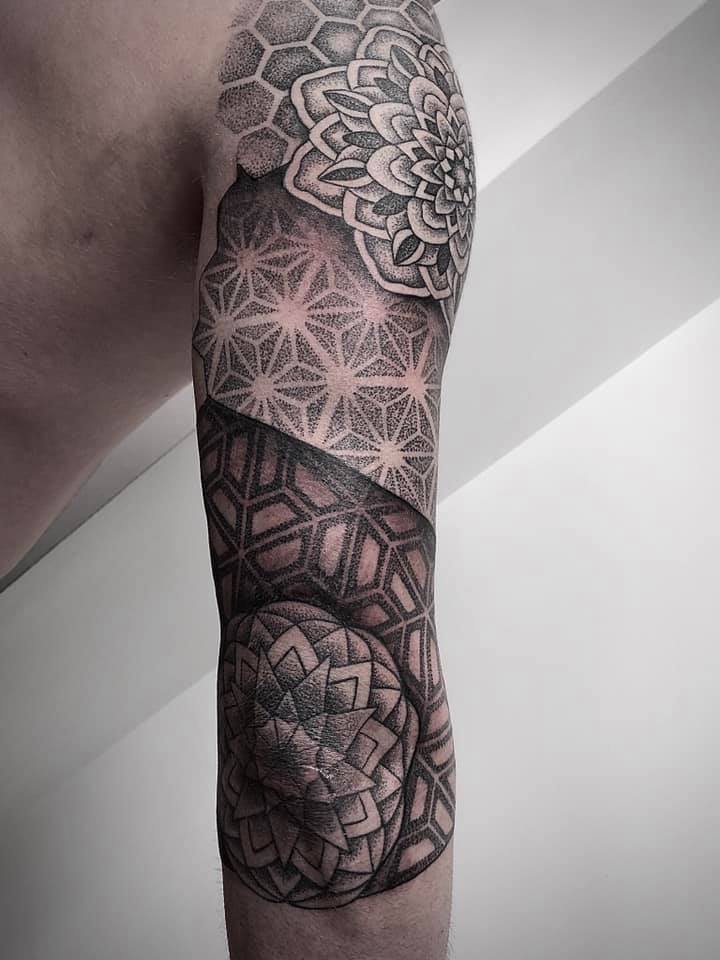
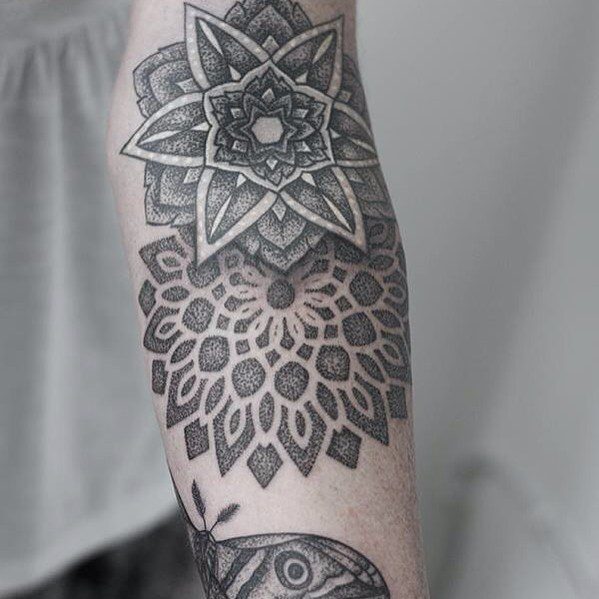
Instead of using conventional smooth shading, thousands of individual dots can create transitions from light to dark.
This allows the underlying geometry to remain visible while still giving the tattoo depth.
Dotwork can also soften very rigid geometry. A hard black line next to a gradual field of dots creates a nice contrast between absolute structure and texture.
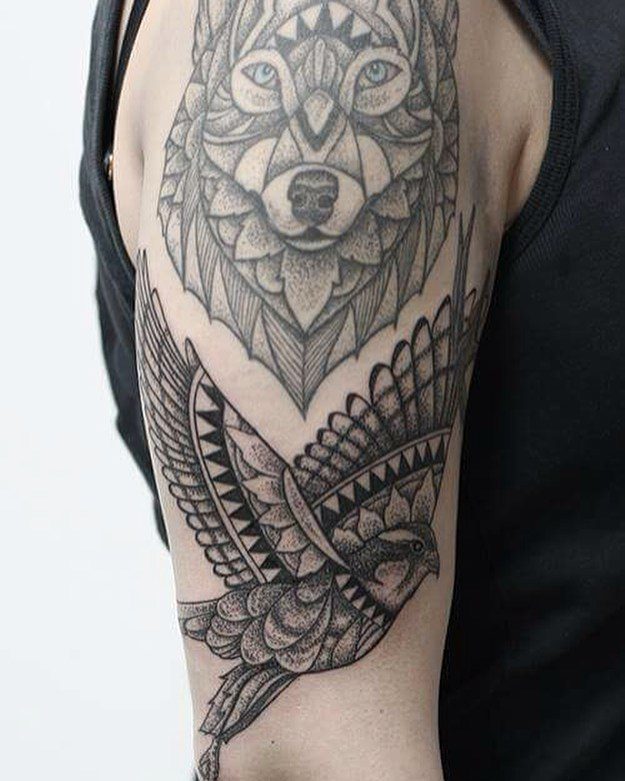
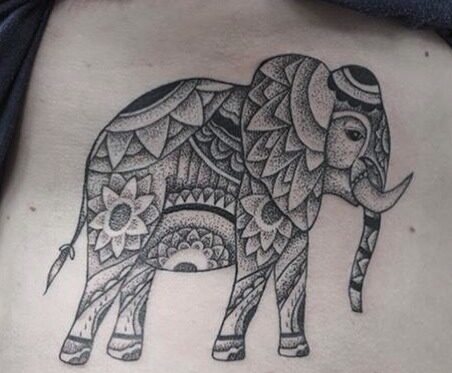
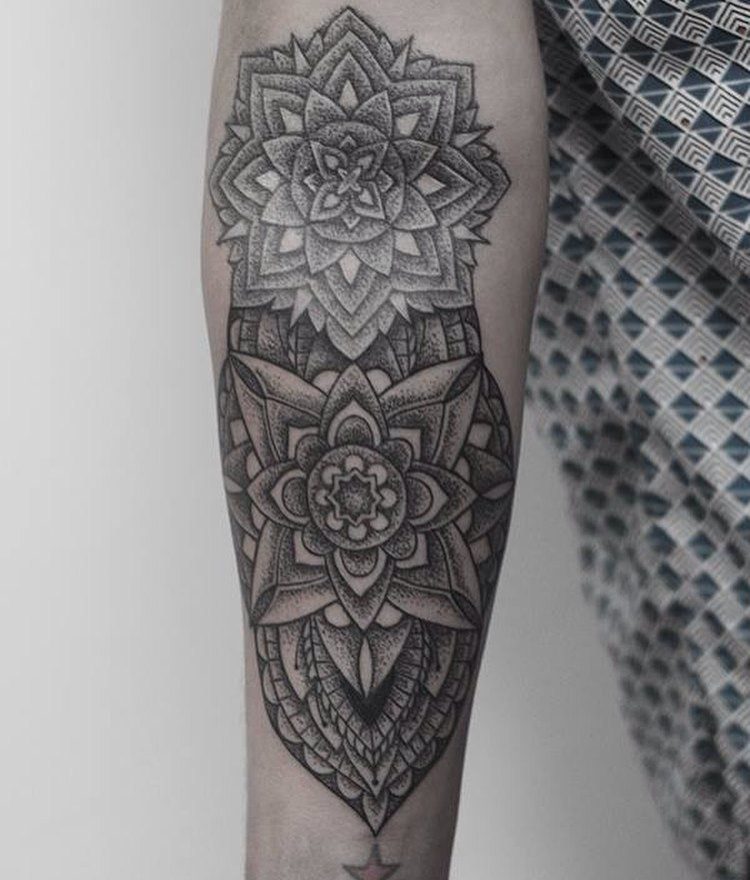
It works particularly well in mandala-style pieces, geometric sleeves and designs where one shape appears to emerge from another.
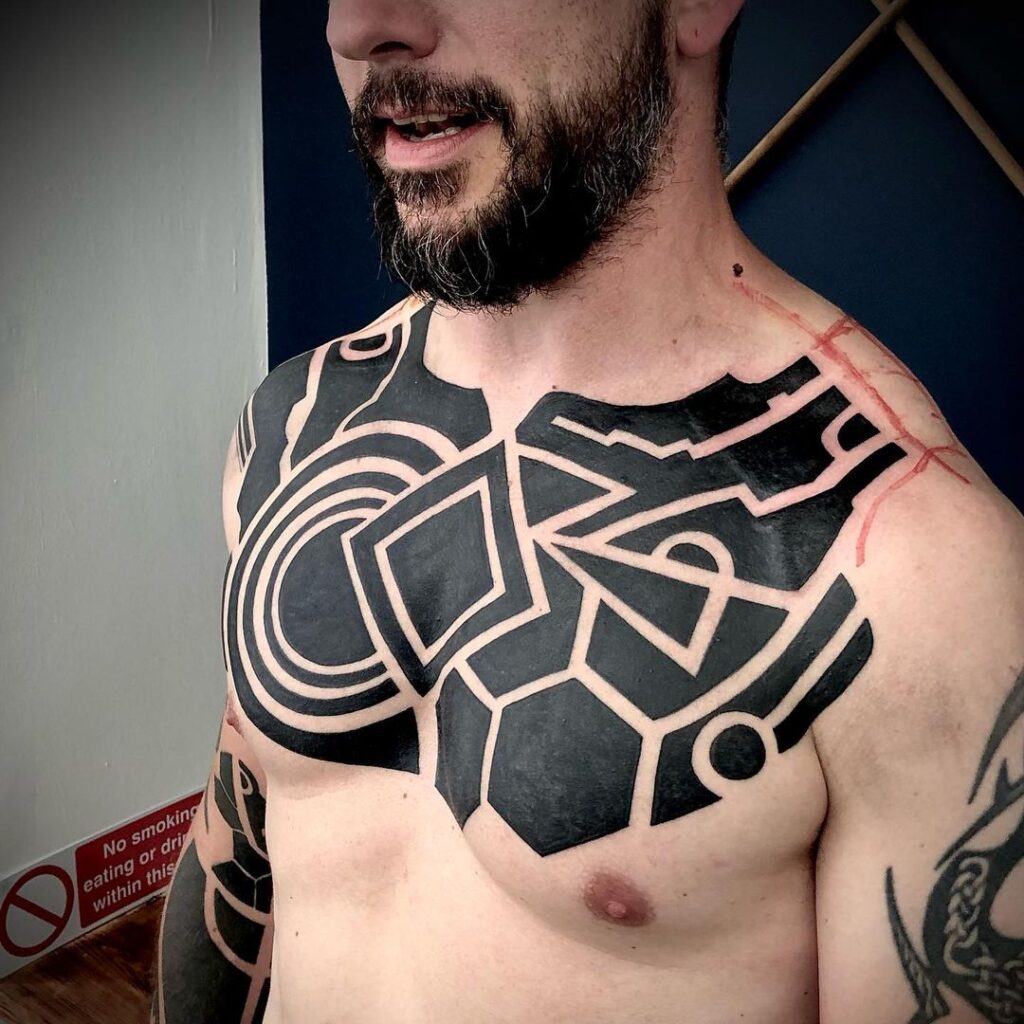
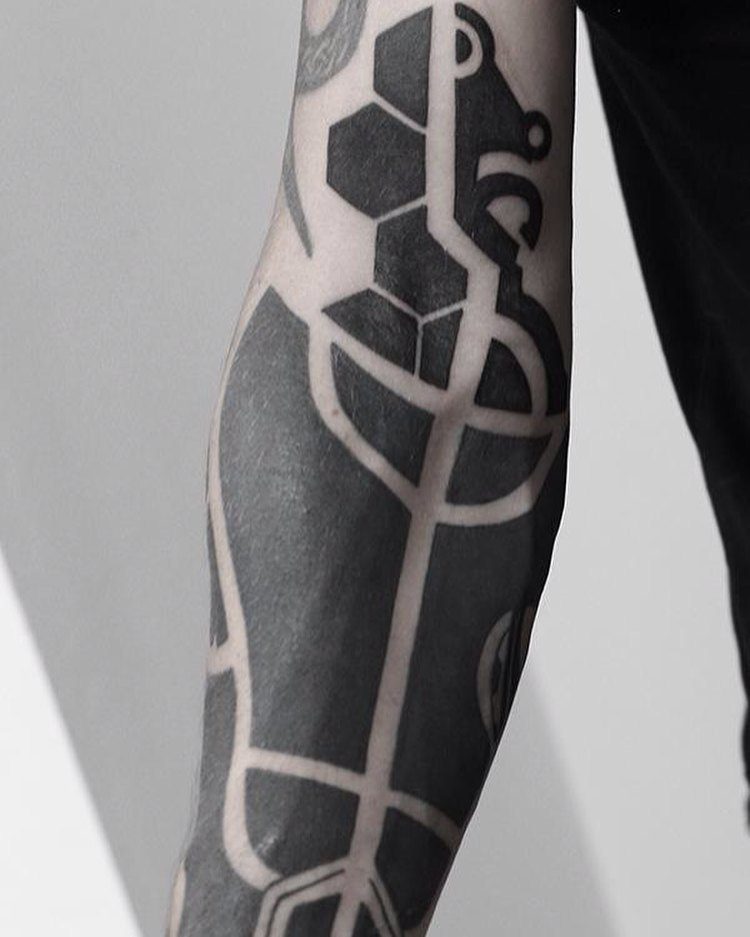
Blackwork Geometry
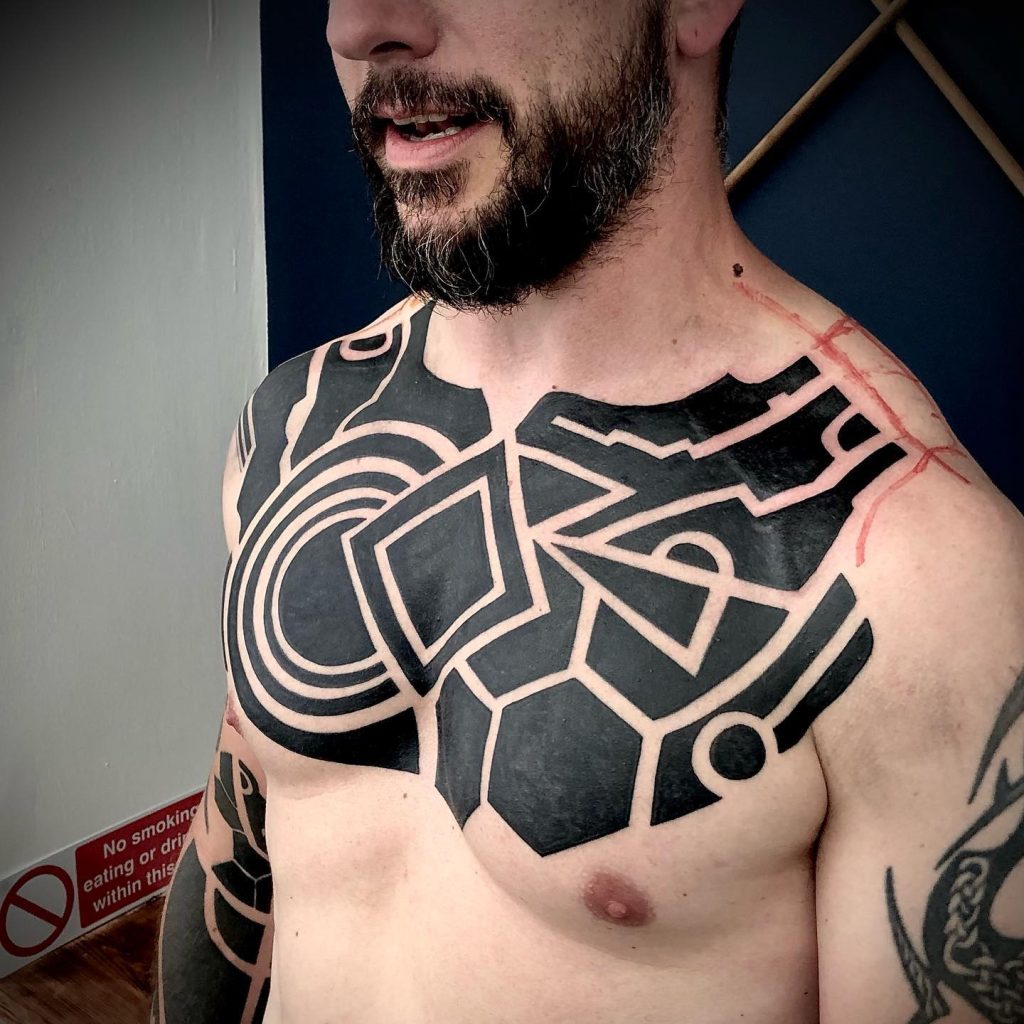
At the other end of the scale is blackwork.
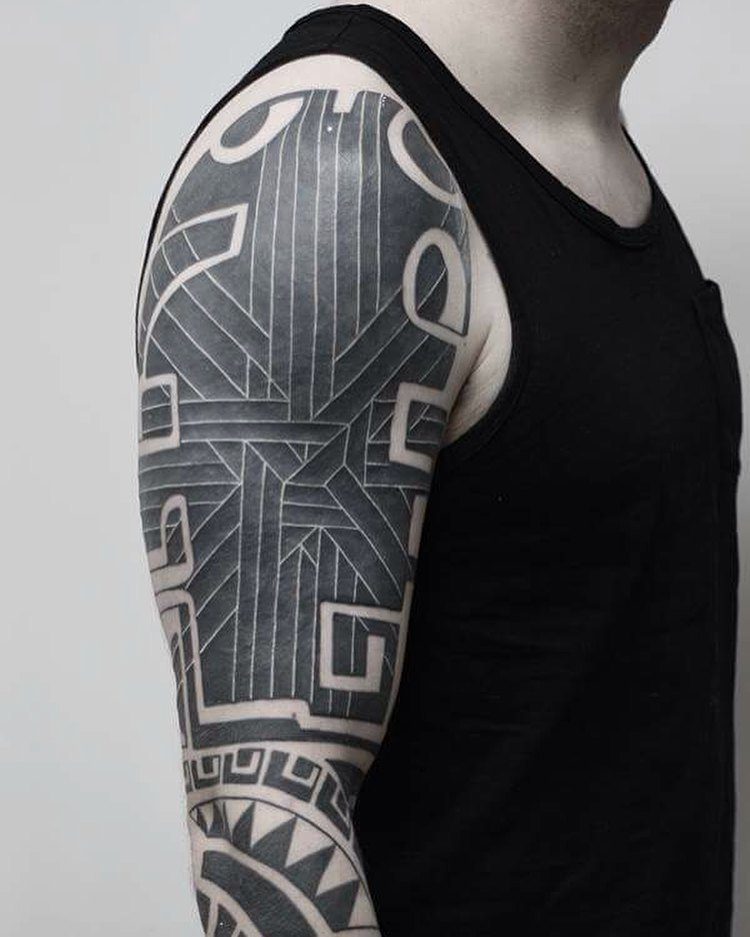
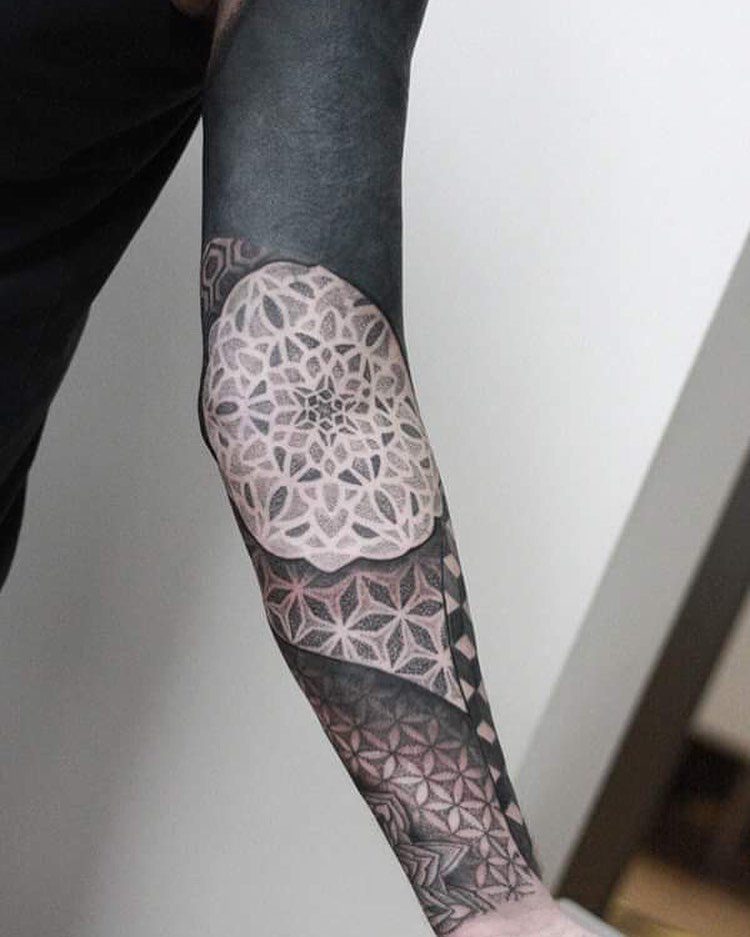
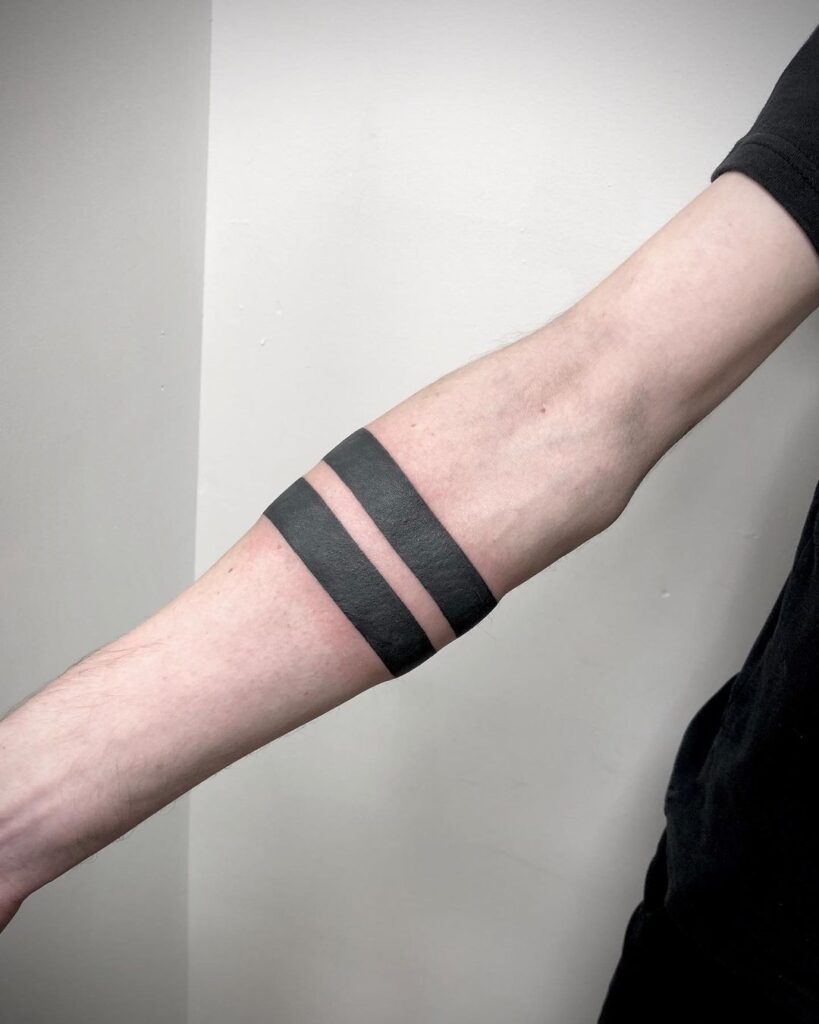
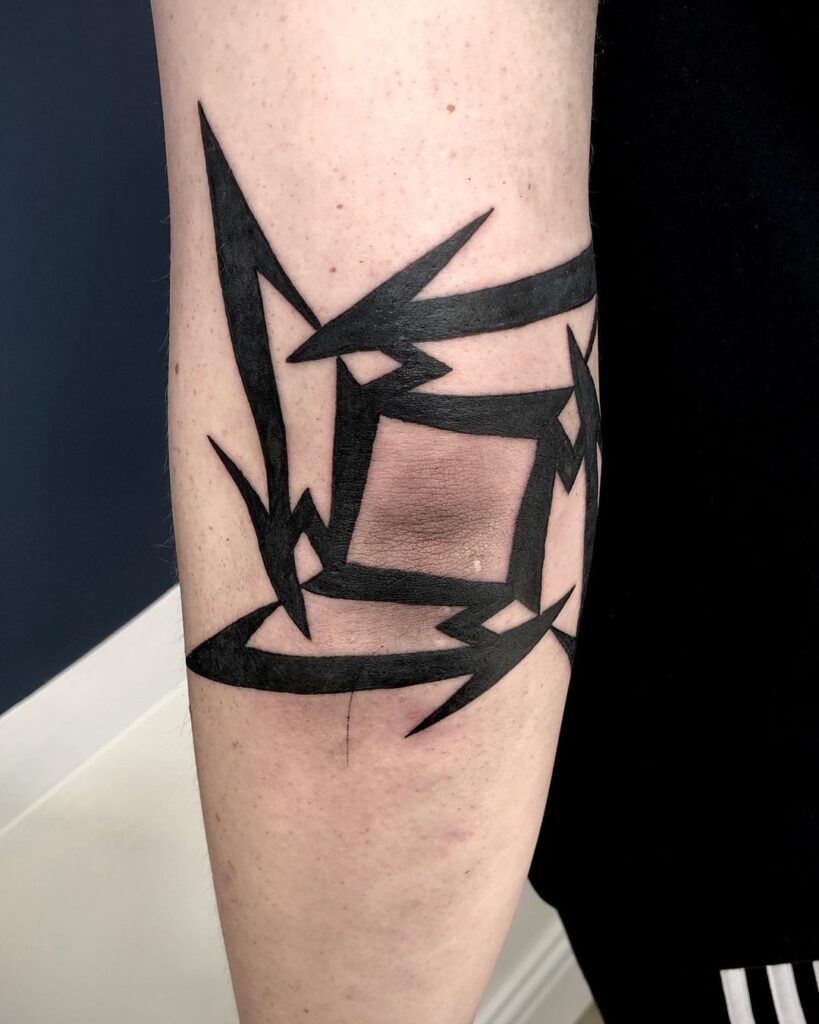
Large areas of solid black can be combined with untouched skin to create very bold geometric patterns.
Negative space becomes just as important as the ink.
This can work brilliantly for repeating patterns, large ornamental pieces and tattoos designed to follow the shape of an arm or leg.
It also tends to be readable from further away than very fine geometric work.
That’s something worth thinking about when choosing references.
Most tattoo inspiration is now viewed close-up on a screen. Your tattoo won’t normally be viewed from six inches away under studio lighting.
How it reads from across a room matters too.
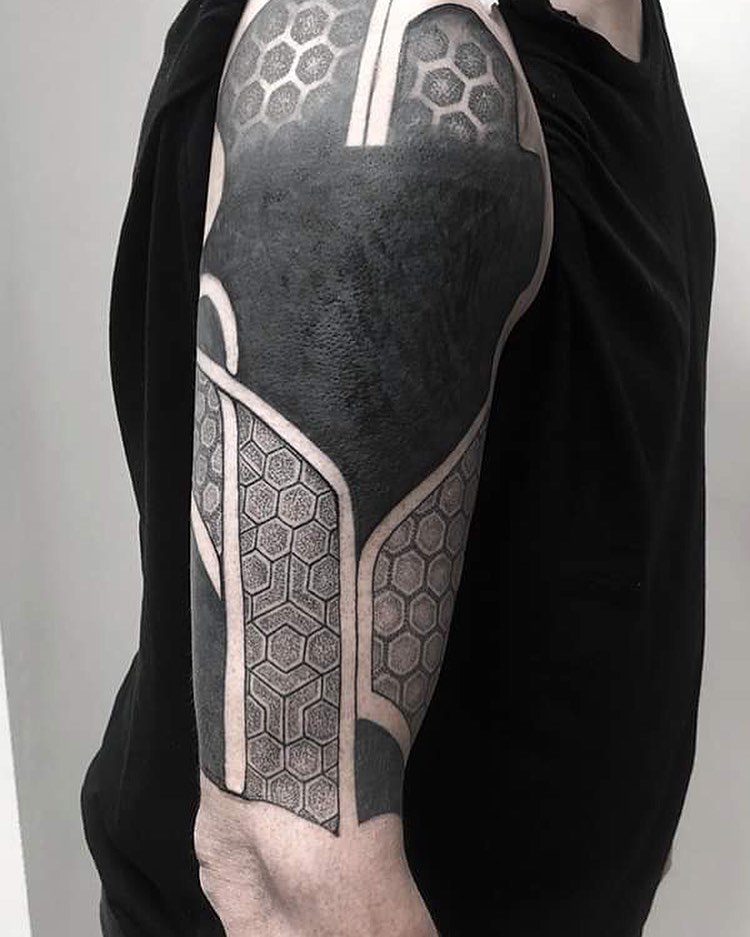
Geometric Patternwork
You don’t necessarily need a central sacred symbol at all.
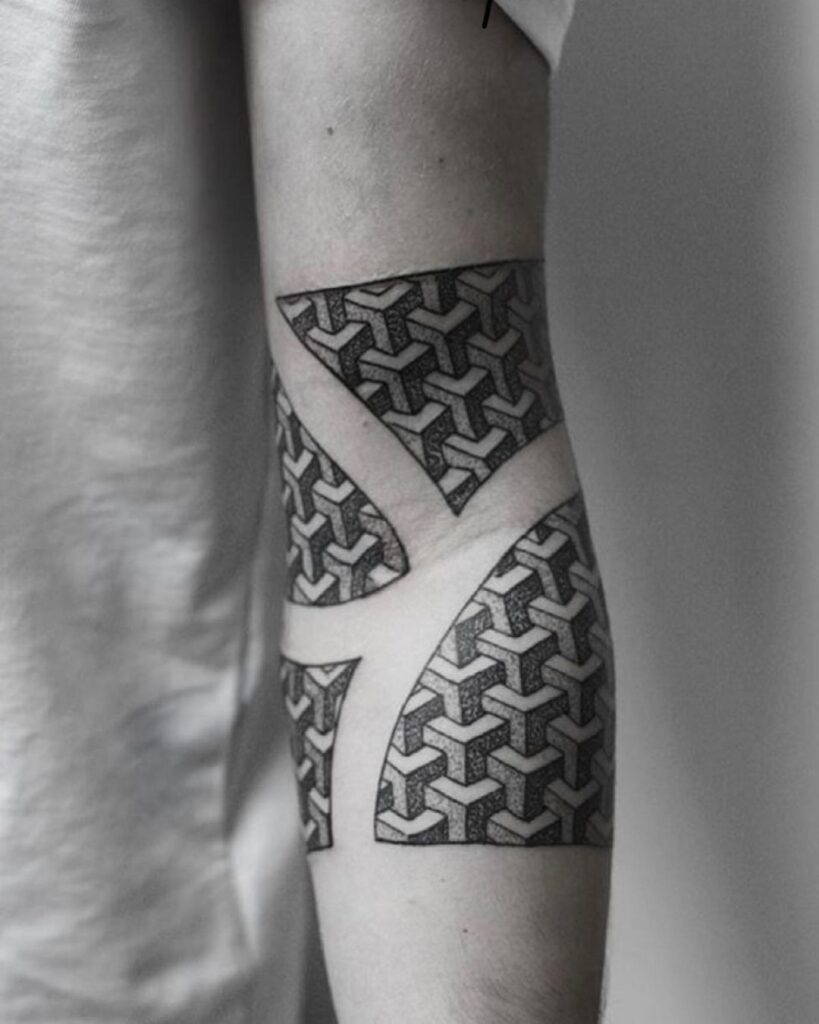
Repeating geometric patternwork can create a tattoo entirely through rhythm and structure.
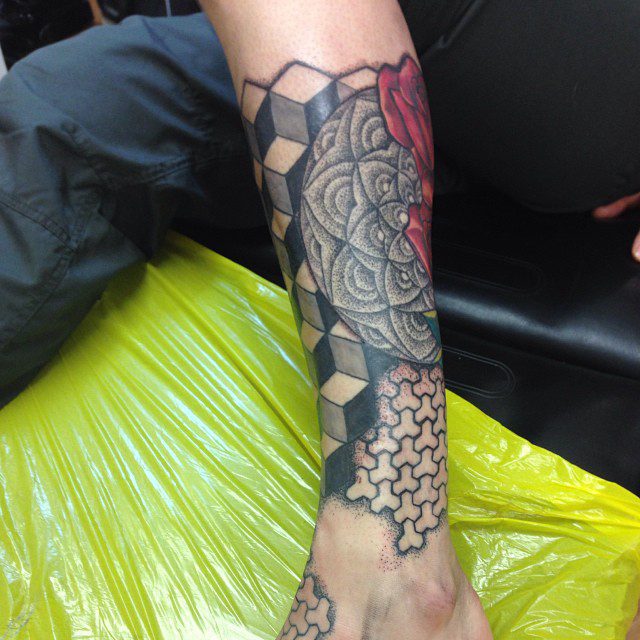
That might mean tessellation, repeated circles, interlocking polygons, bands of geometry or a pattern that gradually changes as it moves around the body.
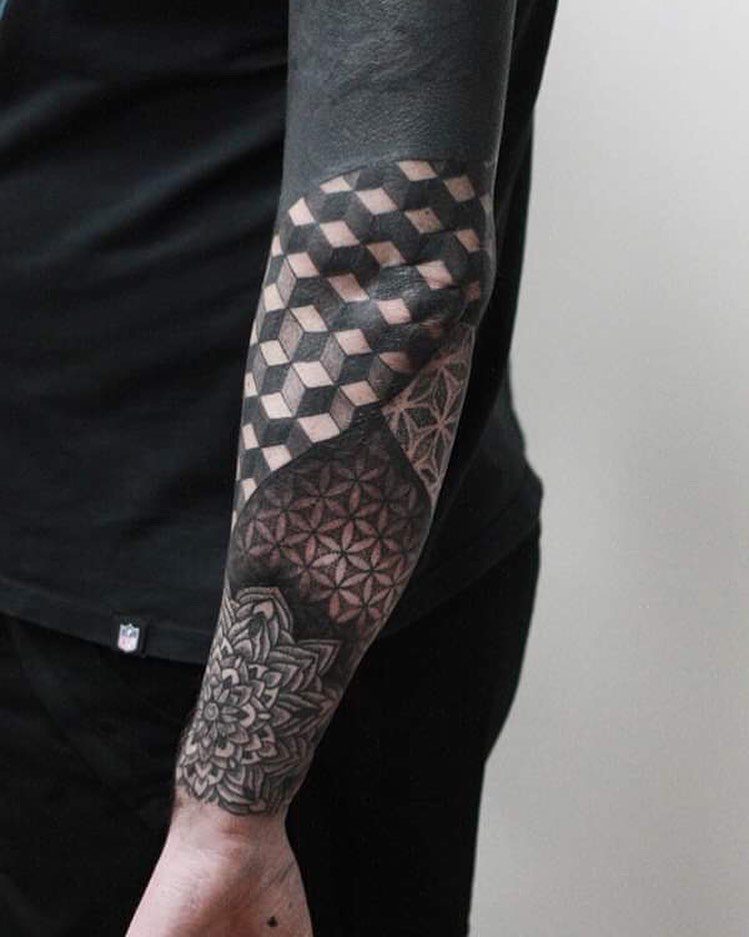
These designs become particularly interesting at larger scales because the body itself starts influencing the pattern.
A sleeve, for example, isn’t a rectangular drawing wrapped around a cylinder.
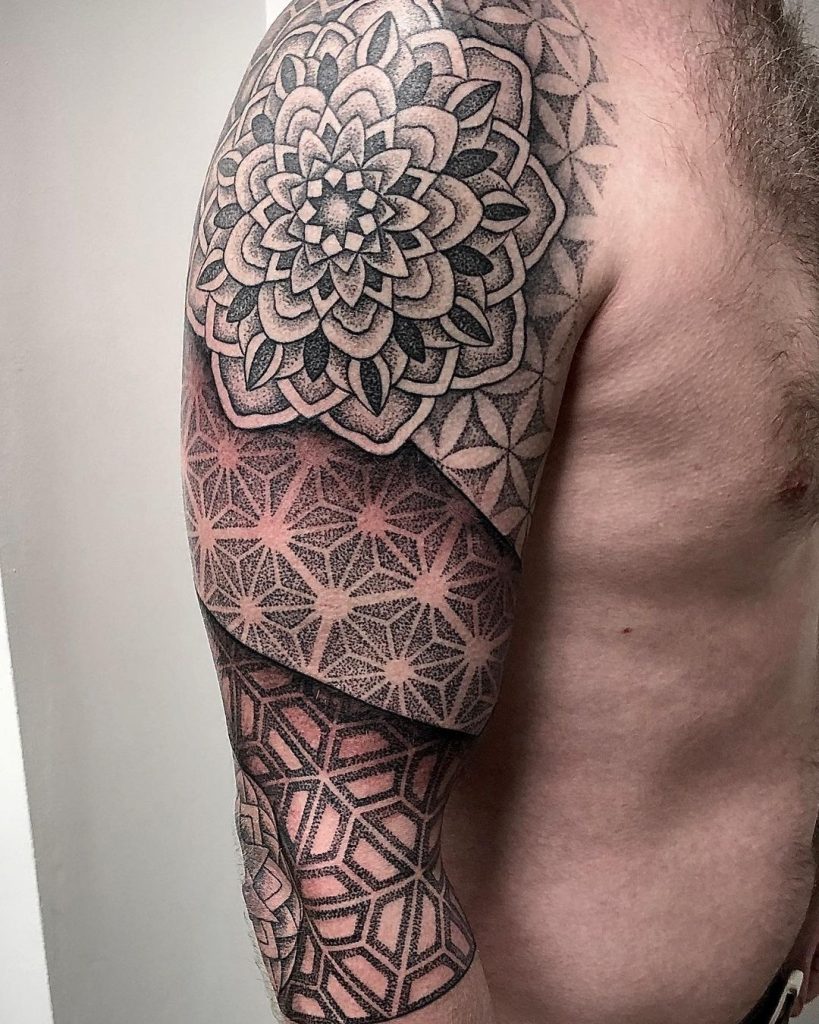
The wrist, forearm, elbow, bicep and shoulder all have different shapes and move differently. A good pattern has to account for that.
Optical and Three-Dimensional Geometry
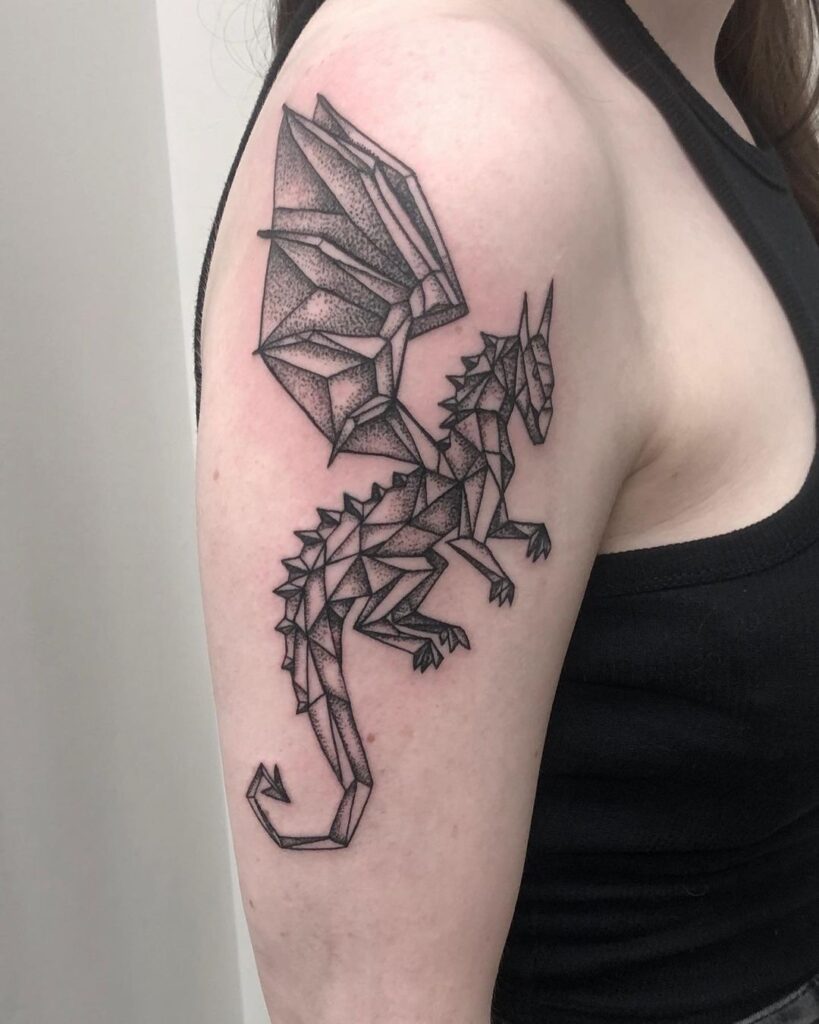
Cubes, impossible forms, layered polygons and perspective-based geometry can create tattoos that appear to move in and out of the skin.
Some designs almost become optical illusions.
This style can be very effective, but precise construction matters because the illusion depends on the relationships between the lines.
Change one angle and the shape may stop making visual sense.
Sacred Geometry Combined With Nature
You don’t have to choose between geometric and illustrative tattooing.
Some of the most interesting designs combine the two.
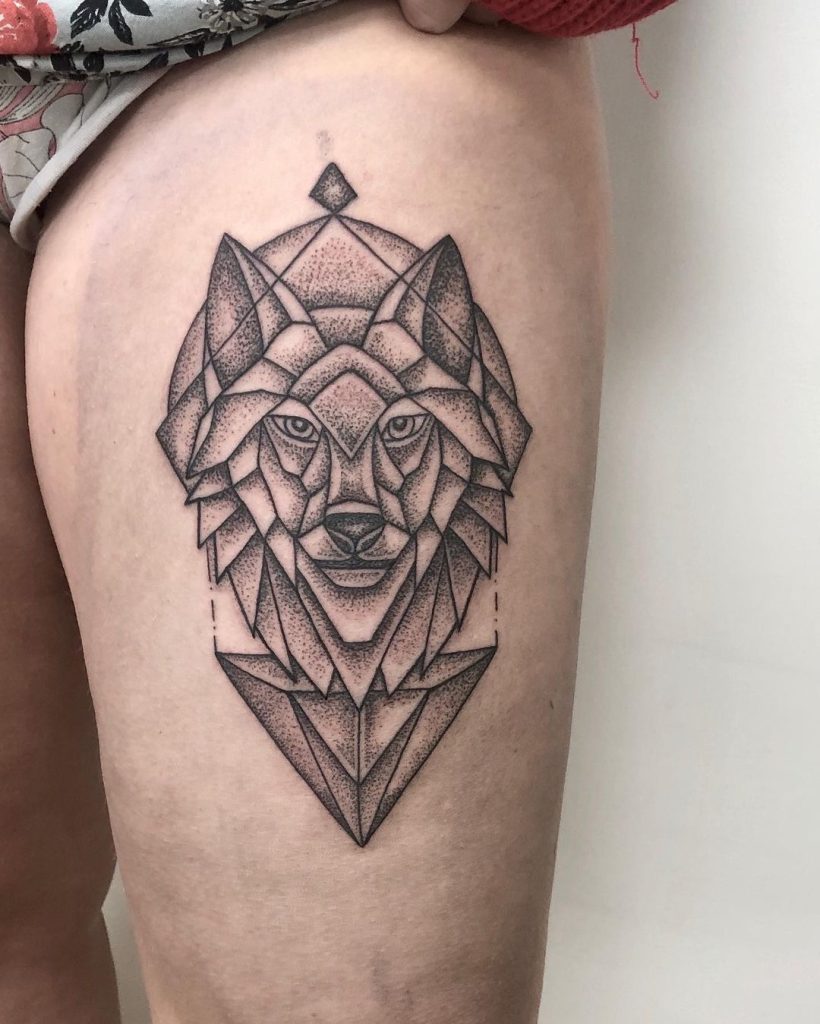
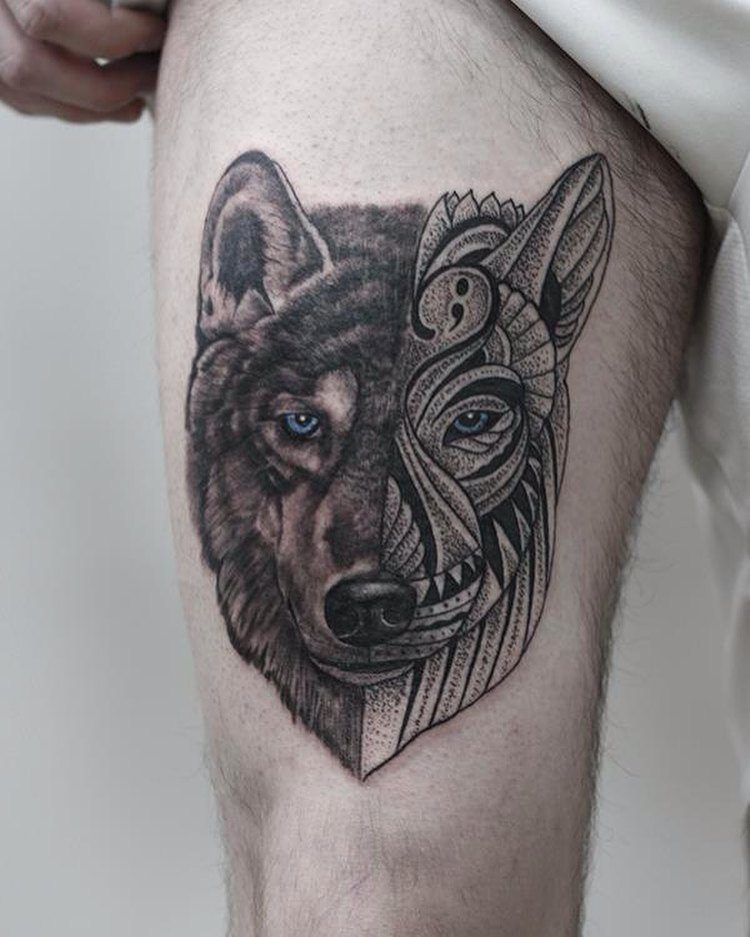
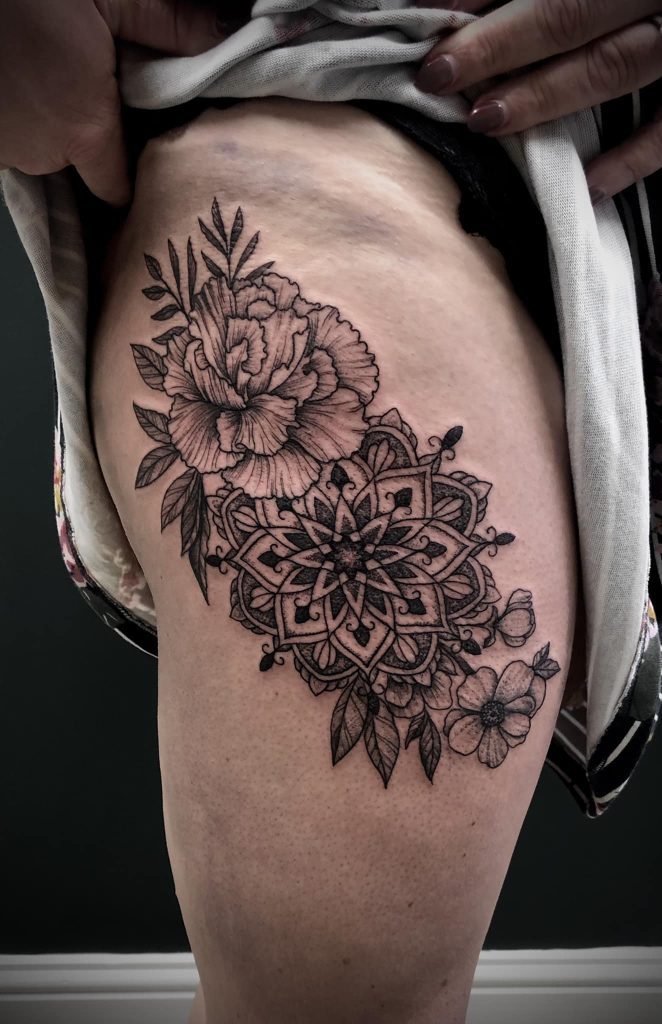
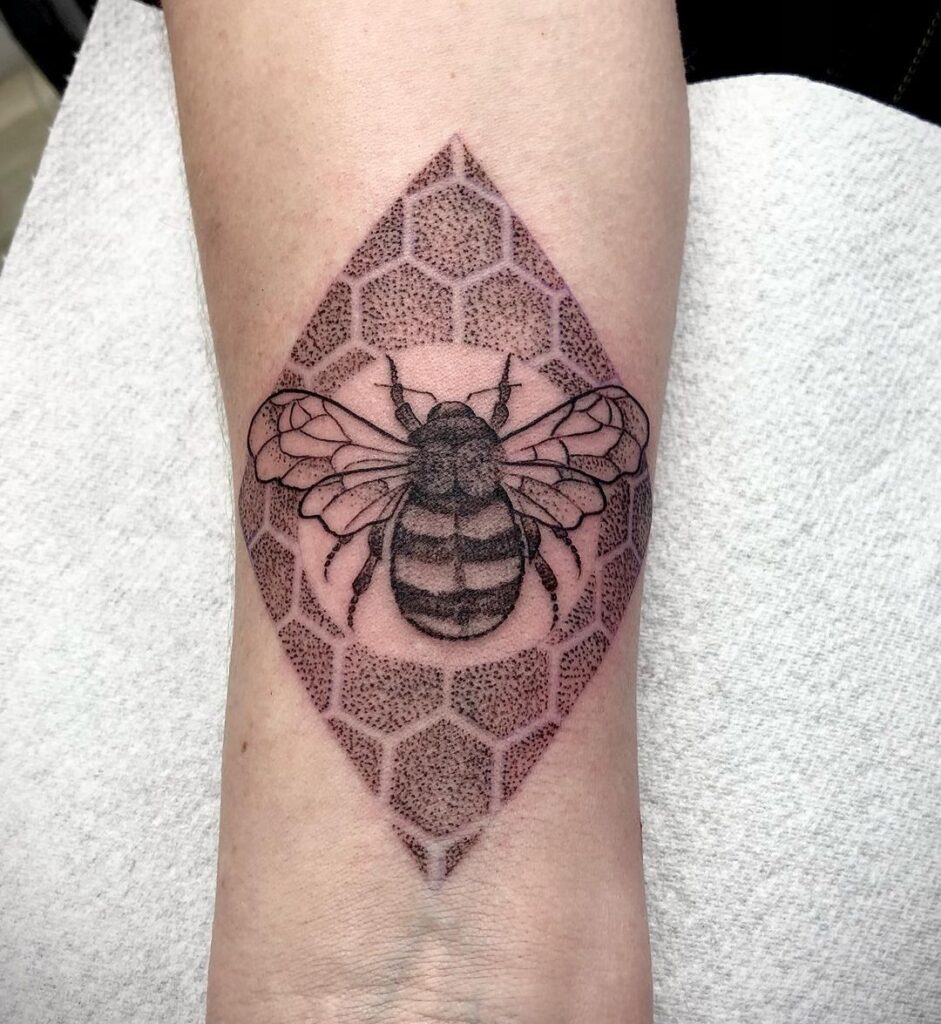
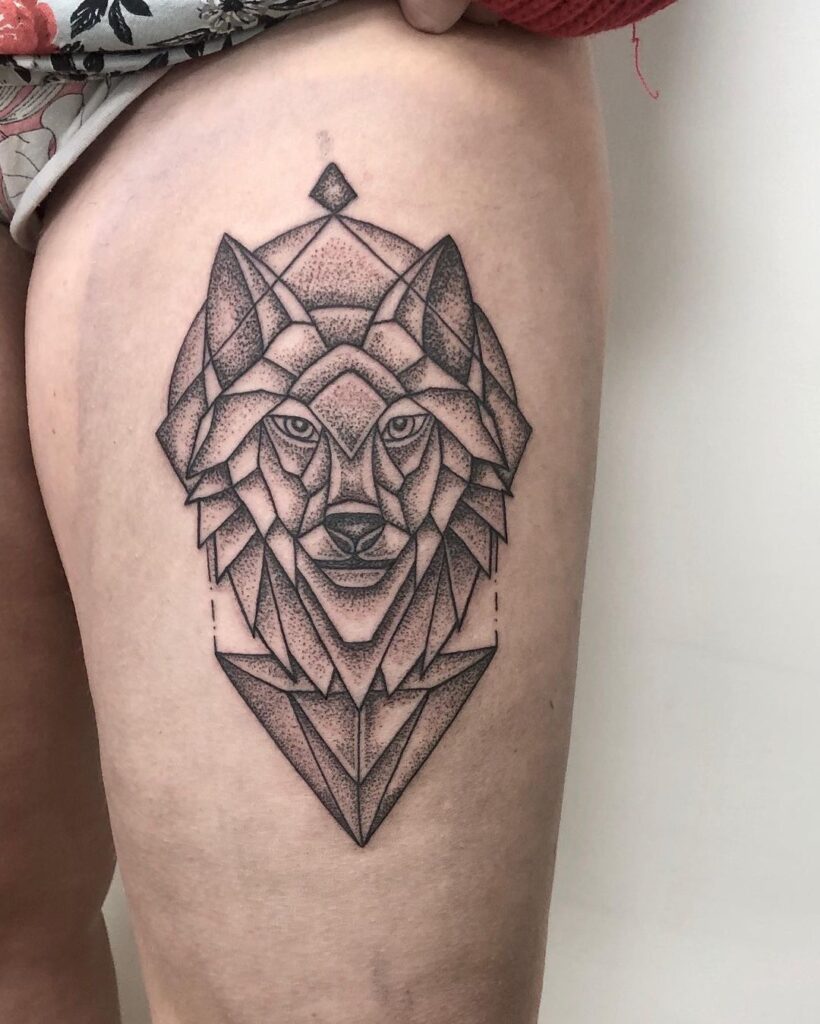
A flower can emerge from a geometric framework. An animal can be partially constructed from polygons before becoming more realistic. Geometry can sit behind a moth, frame a landscape or disappear gradually into leaves and organic forms.
The contrast is what makes it work.
Nature is full of irregularity. Geometry gives you order.
Putting the two together can create a tattoo that feels less like a diagram while still retaining the structure that attracted you to sacred geometry in the first place.
Choosing the Right Sacred Geometry Tattoo
I’d start with the artwork rather than trying to force yourself to find a profound meaning.
Sometimes people arrive at tattoo ideas the other way around. They discover a design they love and then feel as though they need to justify it by finding out what it “means”.
You don’t.
You can get a geometric tattoo because you’re fascinated by mathematics. You can choose one because of a religious or philosophical connection. You can attach your own personal meaning to it.
And you can choose it simply because you think it looks bloody good.
Where I would do some homework is when the design comes directly from a living religious or cultural tradition.
If you’re considering something like a Sri Yantra or a traditional Buddhist mandala, understanding what you’re putting on your body seems like a reasonable amount of effort to make before the tattoo.
It may also change the way you want the design handled.
The same principle applies to other historically or culturally significant tattoo imagery. If Nordic art is something you’re considering as well, I’ve written a separate guide to Nordic tattoos, their symbolism and the different styles you can explore.
Simple or Complex?
More detail doesn’t automatically make a better geometric tattoo.
Sometimes a circle and a few beautifully placed lines have far more impact than a design containing hundreds of intersections.
The right amount of complexity depends partly on size.
If you want a small tattoo, simplifying the geometry usually gives it more room to breathe.
If you’re considering a back piece, chest piece or full sleeve, you have the physical space to introduce much more detail without everything fighting for attention.
This is where I’d avoid becoming too attached to the exact size of an image you’ve found online.
Show your tattoo artist the design and where you want it. If they suggest making it larger, there is usually a practical reason for it.
Where Should You Put a Sacred Geometry Tattoo?
Placement can completely change geometric artwork.
With some tattoos you can design the image first and then find somewhere suitable for it.
With larger geometry, I prefer to think about the body and design together.
Forearm
The forearm gives you a reasonably long area to work with and is particularly suited to elongated geometric designs.
Patterns can run vertically or wrap around the arm.
Just remember that the forearm rotates. Something that appears perfectly straight with your palm facing up may look quite different when your hand turns over.
Upper Arm
The upper arm gives you more circumference and allows patterns to wrap around the body.
It can also connect naturally into the shoulder if you later decide to extend the tattoo.
For repeating geometric work, that gives you plenty of options.
Shoulder
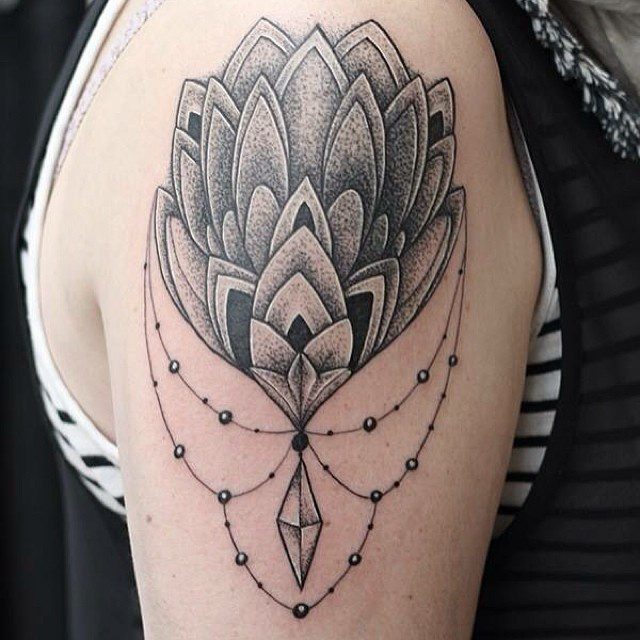
The rounded shape of the shoulder works particularly well with radial geometry.
A mandala-style design can use the shoulder itself as the centre and expand outward rather than simply sitting on top of it like a sticker.
Chest and Sternum
The centre line of the body gives you an obvious reference for symmetrical designs.
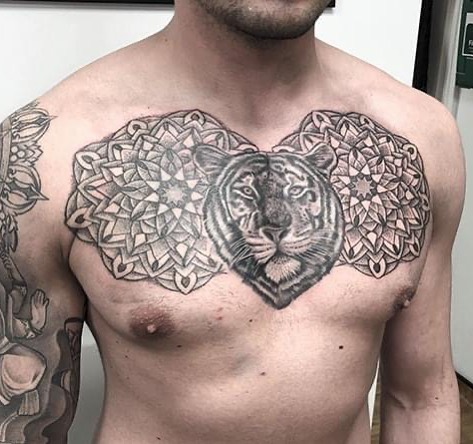
Large geometric tattoos can spread across the chest, while narrower vertical compositions can follow the sternum.
Symmetry becomes especially noticeable here, so positioning matters enormously.
Back
If you want to go big, the back gives you space.
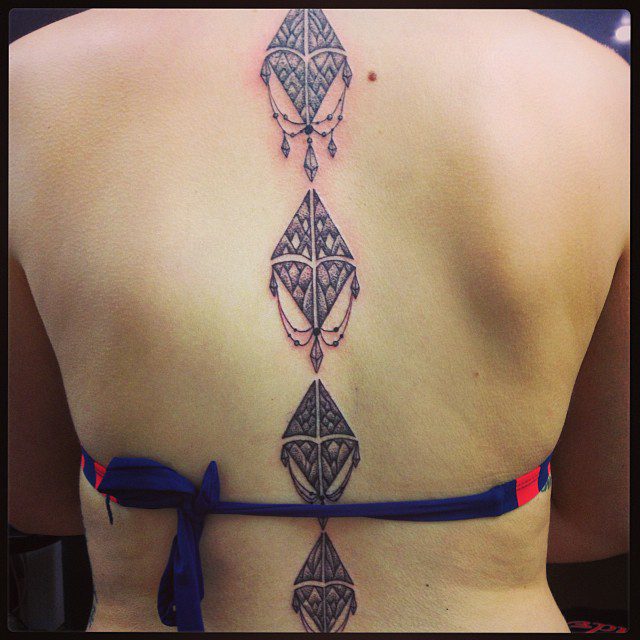
A large central geometric structure can contain far more detail than would be sensible on a forearm, and there is enough room to allow complicated patterns to expand without everything becoming cramped.
The back isn’t completely flat, of course.
The spine, shoulder blades, muscles and movement of the shoulders still affect how the design sits.
Elbows and Knees
These joints offer an interesting natural centre for radial designs.
They are also constantly moving.
That needs to be considered during the design rather than trying to force a perfectly flat pattern over the joint afterwards.
Hands
Geometric hand tattoos can be very striking because the structure of the hand gives you natural lines and focal points to work with.
Hands also take a lot of wear and are highly exposed.
If you’re considering very fine detailed geometry on the hands or fingers, it’s worth having a realistic conversation with your artist about how that particular design is likely to hold up.
Why Precision Matters So Much
Geometry is unforgiving.
If a circle isn’t circular, you see it.
If two lines that are supposed to be parallel gradually move together, you see it.
If a repeating pattern changes spacing halfway through, you see that too.
There are two parts to getting this right.
The first is constructing the artwork accurately.
The second is transferring and tattooing that artwork onto skin.
Those aren’t the same skill.
You can produce mathematically perfect geometry on a computer in seconds. Putting it onto a shoulder, wrapping it around an arm and making it still appear balanced when the person moves is another problem entirely.
The Human Body Isn’t a Flat Canvas
This is probably the biggest thing I’d want somebody to understand before choosing a complicated geometric tattoo.
A lot of sacred geometry references are flat images.
Your body isn’t.
Imagine drawing a perfect circle on a balloon and then changing the shape of the balloon. The circle changes with it.
Skin behaves in a more complicated way, but the basic problem is similar.
Your shoulder changes shape as you lift your arm. Your forearm rotates. Your elbow bends. Muscles contract and relax.
If I simply take a perfectly symmetrical flat design and transfer it without thinking about the body underneath it, it may only look “perfect” from one very specific angle.
Sometimes a geometric tattoo needs small adjustments precisely so that it looks right when it’s being worn.
That’s where tattoo design stops being purely about geometry and becomes about anatomy as well.
Choosing a Tattoo Artist for Sacred Geometry
Look closely at an artist’s portfolio.
Don’t just look for sacred geometry. Look at the fundamentals.
Are the circles clean? Do repeated lines remain consistent? Are symmetrical designs actually symmetrical? Does the spacing look controlled?
If there’s dotwork, look at how smoothly the density changes rather than simply how impressive the finished photograph looks.
I’d also look for healed work whenever possible.
Fresh tattoos naturally photograph well. The skin is new, the black is saturated and everything has just been completed.
Seeing healed tattoos tells you something different.
If you’re planning a large piece, it’s also worth finding somebody who can design for the body rather than simply reproduce a geometric image you’ve downloaded.
Bring references. Bring several if you have them.
They help establish what you’re attracted to.
But I’d use those references as a starting point rather than asking somebody to copy another person’s finished tattoo line for line.
Your body gives us a different canvas anyway. We might as well use it.
Black and Grey or Colour?
Most sacred geometry tattoos you’ll encounter are predominantly black.
There’s a practical reason for that as well as an aesthetic one.
Black gives geometric structure clarity. Lines, intersections and negative space remain easy to read without colour competing for attention.
That doesn’t mean geometry has to be monochrome.
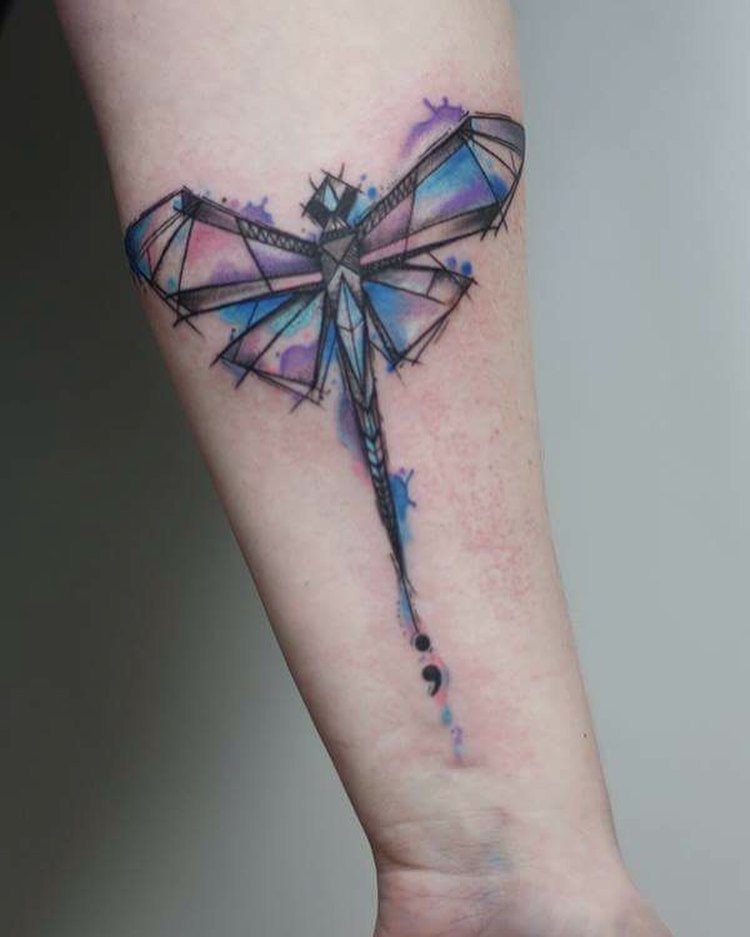
Colour can be introduced selectively inside different sections of a pattern, used behind black geometry, added through natural elements or incorporated as a gradual transition.
The question is whether the colour is helping the composition.
If the geometry is already complicated, adding several competing colours can sometimes make the design harder to read rather than more interesting.
How Do Sacred Geometry Tattoos Age?
All tattoos change with time.
That’s normal.
The aim isn’t to create something that will remain microscopically identical for the next forty years. Skin doesn’t work like that.
The aim is to design and tattoo something with enough space and clarity that those normal changes don’t destroy the artwork.
With geometry, spacing is particularly important.
Imagine several very fine parallel lines with tiny gaps between them. If those lines settle and soften slightly over the years, the gaps have less room to accommodate the change.
Give the same lines more space and the overall pattern remains much clearer.
This is one reason I may recommend increasing the size of an intricate design.
I’m not trying to sell you more tattoo.
I’m trying to give the detail somewhere to live.
Negative space is part of the tattoo.
Preparing for Your Tattoo
Once the design, size and placement have been decided, preparation is fairly straightforward.
Turn up rested, eat properly beforehand and keep yourself hydrated. Don’t arrive with sunburnt or damaged skin where you’re expecting to be tattooed.
For longer sessions, wear something comfortable that gives easy access to the area we’re working on.
Afterwards, follow the aftercare instructions your tattoo artist gives you.
There are different products and healing methods in use, and your artist knows how the tattoo was applied and how they want you to look after their work.
The long-term advice is simpler.
Look after your skin and protect your tattoos from excessive sun exposure. UV exposure contributes to tattoo fading just as it contributes to changes in untattooed skin.
Thinking About a Sacred Geometry Tattoo?
You may already have a very specific symbol in mind.
Or you might have saved twenty images and realised the only thing they have in common is that you like circles, symmetry and lots of tiny dots.
That’s fine too.
You don’t need to arrive with a finished tattoo design.
In fact, I’d rather work from your ideas, references and the area of the body you’re considering than simply copy a finished tattoo somebody else is already wearing.
I’ve been tattooing for more than 20 years, and part of my job is taking the thing you have in your head — even when it’s still fairly vague — and working out how to turn it into a tattoo that actually works on your body.
If you’re considering a sacred geometry tattoo and want to talk through the design, size or placement, get in touch with me to arrange a free consultation about your sacred geometry tattoo idea.
Portfolio Review
Always review the artist’s portfolio of nordic tattoos (you can see mine here) to get a sense of their style and experience with Nordic designs. Look for clean, sharp lines, well-executed lettering, and attention to detail. A good portfolio will give you confidence in the artist’s ability to bring your vision to life.
Sacred Geometry Tattoo FAQs
What does a sacred geometry tattoo mean?
There isn’t one universal meaning.
“Sacred geometry” now covers a wide range of geometric designs drawn from religious traditions, philosophy, mathematics and modern spirituality. The meaning depends on the particular design and, in many cases, what the person wearing it associates with it.
If you’re using a symbol from a particular religious tradition, its established meaning is worth researching separately from modern tattoo interpretations.
What are some popular sacred geometry tattoos?
The Flower of Life, Seed of Life, mandala-style designs, Metatron’s Cube, Sri Yantra and geometric representations of Platonic solids are all commonly encountered in contemporary tattooing.
They vary enormously in complexity, so the appropriate size and placement will depend on the design.
What does a Flower of Life tattoo mean?
Modern sacred-geometry traditions commonly associate the Flower of Life with ideas such as creation, unity and interconnectedness.
Be cautious about claims that every modern meaning attached to it comes from an ancient universal tradition. Intersecting-circle geometry has a long history, but the modern Flower of Life system and the collection of meanings surrounding it are considerably more recent.
Is Metatron’s Cube an ancient symbol?
Metatron is an established figure in Jewish mystical literature, but the familiar geometric design now called Metatron’s Cube isn’t securely documented as an ancient Kabbalistic symbol.
Its current name and meanings are better understood in the context of modern Western esotericism and contemporary sacred geometry.
Where is the best place for a sacred geometry tattoo?
There isn’t one best location.
Shoulders suit radial patterns, backs and chests provide room for large symmetrical designs, and arms work well for repeating or wrapping geometry.
The shape and movement of the body should be considered when the tattoo is designed rather than choosing placement purely from a photograph of somebody else’s tattoo.
Do geometric tattoos need a specialist tattoo artist?
They benefit from an artist who is comfortable with precise linework, symmetry, repetition and designing geometry around the body.
Look carefully at an artist’s portfolio, particularly healed examples if available.
Do fine-line geometric tattoos age well?
They can, but size and spacing matter.
Putting a large amount of very fine detail into a tiny area gives the design less room to accommodate the natural changes that happen to tattooed skin over time.
An experienced artist should be able to advise whether the design needs simplifying or enlarging.
Can you design a custom sacred geometry tattoo?
Absolutely.
You don’t need to find a finished tattoo online and copy it. A custom piece can take the symbols, patterns or geometric style you’re interested in and develop them specifically for your body, placement and preferred scale.
That usually produces a much more interesting tattoo anyway.
Get in touch with me to arrange a free consultation.